
Why Archaeopteryx Is No Longer the First Bird
Explore the shifting definition of "true birds" and why the most famous fossil in history has been demoted by modern science.
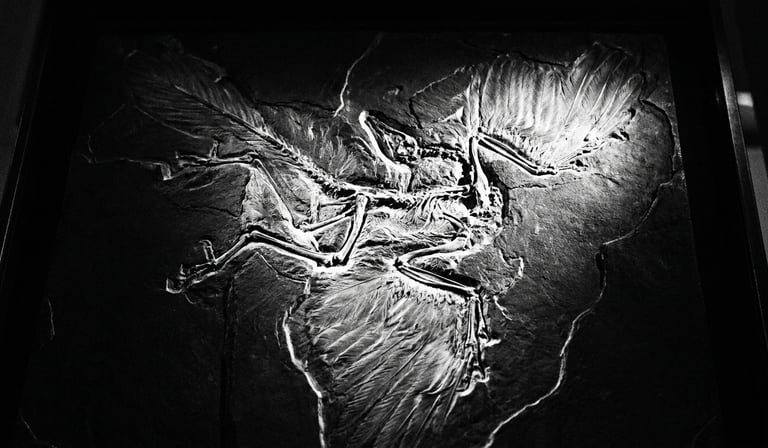
The distinction between a dinosaur and a bird was permanently blurred in 1861 when a single fossilized feather was discovered in a Bavarian limestone quarry. According to documentation from Biology LibreTexts, that specimen, eventually named Archaeopteryx lithographica, appeared roughly 150 million years ago. It possessed the feathers of a bird but the teeth and bony tail of a theropod dinosaur. While traditional textbooks once crowned it the first bird, modern phylogenetics has demoted it to a basal member of the clade Avialae. It is no longer the "point of origin" but merely one experiment in a chaotic evolutionary laboratory.
The definition gap mainstream coverage missed
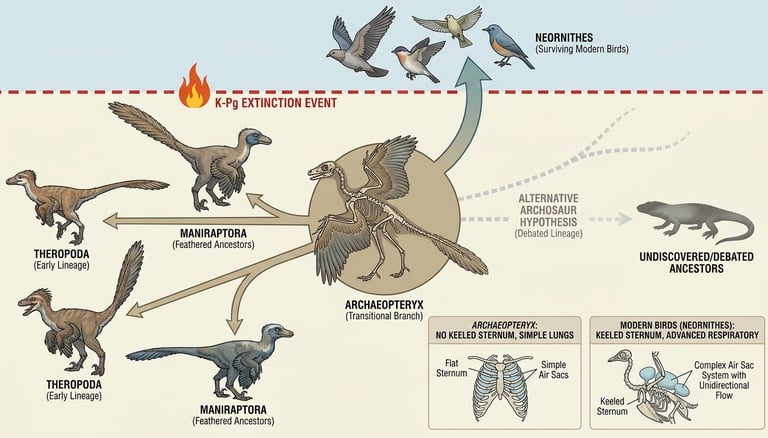
Mainstream reports often treat the transition to "true birds" as a clear line in the sand. The reality is a taxonomic mess that the general public rarely sees. Researchers like Alan Feduccia from the University of North Carolina have long argued for a non-dinosaurian origin of birds, suggesting they evolved from earlier archosaurs. While the scientific consensus represented in the 2026 Comprehensive Global Assessment of Aves favors the theropod lineage, the debate highlights a critical truth: there is no "exact point" where a dinosaur became a bird.
The "true bird" label is usually reserved for the Neornithes, the group that includes all 10,000 living species. These are the only dinosaurs that survived the Cretaceous-Paleogene extinction event 66 million years ago. Archaeopteryx is excluded from this inner circle because it lacks the fused breastbone (carina) and the specialized respiratory system required for sustained, high-efficiency flight found in modern species. It was a transitional form that shared the world with many other feathered, flight-capable dinosaurs that simply went extinct.
What this means for conservation in 2026
The reason this technicality matters has nothing to do with museum labels and everything to do with how we value biodiversity. When we realize that modern birds are the sole survivors of a 230 million year old lineage, their current decline takes on a more heavy weight. Data from the IUCN Red List indicates that nearly 13 percent of all bird species are currently threatened with extinction.
If these "living dinosaurs" disappear, we lose the primary drivers of global seed dispersal and insect control. The economic cost of losing avian pest control in North American forests alone is estimated to be billions of dollars annually. When a species like the Saltmarsh Sparrow vanishes, it isn't just a loss of a bird: it is the final snap of an evolutionary thread that began in the Jurassic.
The Science Impact newsletter goes deeper than this, every week. Real analysis. Zero hype. Subscribe free.