
What Five Sigma Means and Why Physicists Demand It
Most particle discoveries confirm existing theory. Learn what five sigma really means and how to read any physics headline critically.
What "Five Sigma" Actually Means and Why Physicists Won't Budge on It
In July 2012, two separate detector teams at CERN ran blind analyses of the same LHC data. Both cleared five sigma for the same signal at the same energy. Peter Higgs, then 83, sat in the front row and cried. What most coverage missed that day was that physicists hadn't been waiting for that specific particle. They'd been waiting for that specific number.
Five sigma wasn't chosen out of preference for precision. It's the answer to a particular statistical problem, and understanding it changes how you read every particle physics headline that follows.
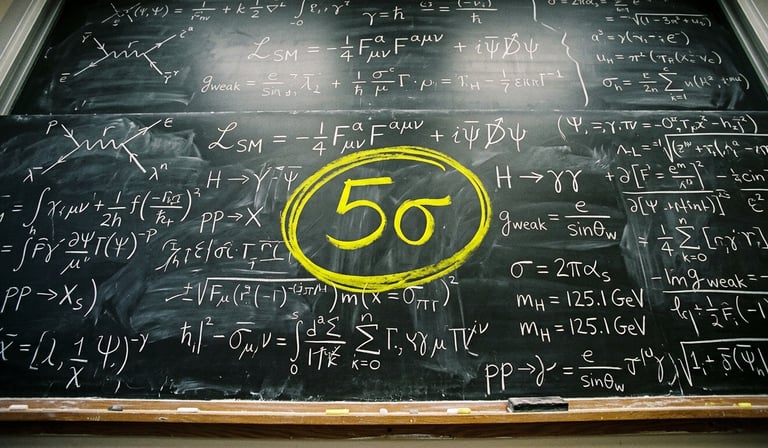
The specific trap here is assuming that "new particle discovered" means physicists found something their theory didn't predict. In the Standard Model, physics' reigning framework for matter and forces, most detectable particles were predicted to exist decades before any machine existed that could find them. The Ξcc⁺, confirmed at CERN in March 2026, was predicted. The Higgs boson, confirmed in 2012, was predicted in 1964 by Peter Higgs and colleagues. The W and Z bosons, which won Carlo Rubbia and Simon van der Meer the Nobel Prize in 1984, were predicted by Sheldon Glashow, Abdus Salam, and Steven Weinberg in the 1960s.
So far, the LHC has confirmed the Standard Model every single time.
Confirmation tells physicists their theory is still holding. A result that doesn't match the model's prediction is a fundamentally different kind of finding. One validates the framework; the other begins to break it. The LHC has done mostly the former. That's not a failure. Each confirmed prediction tightens the mathematical constraints on where the model might eventually crack.
Three Questions Every Physics Headline Demands
The mental model that changes how you read these announcements works in three steps.
Stop assuming sigma equals confidence. A five-sigma result doesn't mean physicists are 99.99997% certain they've found something real, the way you might feel 99% certain after checking the weather twice. It means the probability of seeing that signal from background noise alone, if nothing real were actually there, is about one in 3.5 million. The distinction matters because particle physics runs thousands of simultaneous analyses across billions of collisions. A four-sigma anomaly appearing somewhere in that volume of data isn't unusual at all. Five sigma exists as the threshold specifically because, at that level, background noise can't plausibly explain what's being seen.
Apply a second lens: ask whether the discovery confirms or challenges the theory. If a headline announces a particle the Standard Model predicted, that's confirmation. If it announces a decay rate that doesn't match model predictions, that's a potential challenge. Challenges are rarer, harder to prove, and more significant. The most closely watched results at LHCb aren't new hadrons for the catalogue. They're precise measurements of B-meson and D-meson decay rates, where any deviation from model predictions would signal physics the theory can't currently explain.
Keep updating as hardware changes. The Ξcc⁺ couldn't be confirmed before the LHCb detector's 2023 upgrade, not because the underlying physics changed, but because the previous instrument's data throughput wasn't sufficient. Tim Gershon of the University of Warwick stated plainly that a single year of upgraded data did what a decade of the original detector couldn't. The upgraded system takes 40 million images of particle collisions per second. When a discovery required a methodological advance of that scale, it signals what categories of physics will become observable next.
The Brain Bug That Makes Physics News Sound Bigger Than It Is
Novelty Bias is the tendency to assign disproportionate weight to new information while discounting the accumulated authority of existing evidence. In science journalism, it makes every confirmed baryon sound like a rupture with everything physicists previously knew.
The Standard Model has 17 named fundamental particles. It's survived every experimental test since its development in the early 1970s. The LHC has added 80 hadrons to the catalogue of composite particles. Every one of those additions was predicted, and each one confirmed the model rather than challenged it.
Novelty Bias is most visible in what gets covered versus what doesn't. When LHCb reported anomalies in B-meson decay rates between roughly 2014 and 2022, results that briefly suggested the model's predictions might be off, the coverage was muted compared to the Higgs announcement. As additional data came in and those anomalies shrank, they nearly vanished from mainstream science news. New particles make clean narratives. Tension in a dataset doesn't photograph well.
Those B-meson anomalies, still being analyzed with the upgraded detector, are the signal worth following if you want to know where the Standard Model is actually under pressure.
The physics that will eventually extend the Standard Model won't announce itself with a press conference and an artist's rendering. It'll start as a stubborn number that doesn't quite fit, remeasured more precisely each year until it can't be explained away. That's the story to track. The particle names are just the index.
This is exactly the kind of analysis we publish every week at The Science Impact, before it reaches mainstream news cycles. Subscribe free. Stay a step ahead.