
Viral Animal Welfare Campaigns Hurt the Animals They Claim to Save
PETA wanted Punch the macaque relocated. That would have permanently damaged him. Here's why viral animal welfare campaigns keep producing the wrong outcomes.
Viral Animal Welfare Campaigns Hurt the Animals They Claim to Save
When PETA called for Punch the macaque to be relocated from Ichikawa City Zoo to a wildlife sanctuary, the organization was responding to something real: footage of a seven-month-old primate being chased, pinned, and physically overwhelmed by animals many times his size. The impulse to act on that footage was human, understandable, and scientifically wrong in ways that would have directly harmed the animal if the zoo had complied. The Punch campaign is not an outlier. It's a template for how social media animal welfare advocacy consistently produces outcomes the evidence doesn't support, and occasionally produces outcomes that are actively damaging to individual animals and to conservation priorities.
That pattern has a cost, and it's past time to name it plainly.
Removal from the Troop Was the Worst Outcome the Campaign Was Pushing For
The specific ask in the PETA petition and in the broader wave of online pressure was relocation: get Punch out of that troop and into a sanctuary. What the advocates didn't engage with, because it doesn't compress into thirty seconds of video, is what that relocation would have actually done to the animal.
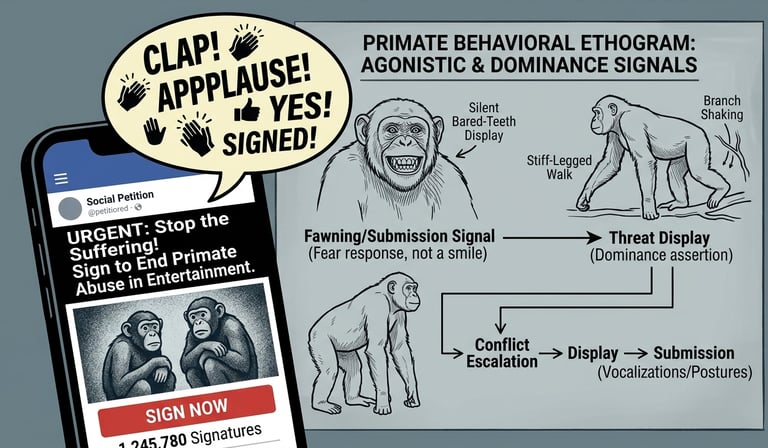
Japanese macaques are obligate social animals with a matrilineal hierarchy so rigid that rank is inherited, not earned. An infant who misses the developmental window for learning subordinate signaling, the specific postures, vocalizations, and behavioral responses to dominant animals, does not catch up as an adult. Research on social deprivation in primates, building on Harry Harlow's foundational 1958 work at the University of Wisconsin and extended by decades of field research on macaque societies, consistently shows that juveniles separated from troop social learning during key developmental windows show permanent deficits in social function. A macaque relocated to a sanctuary and denied normal troop integration doesn't become a happy, protected animal. It becomes an adult that cannot read or produce normal macaque social signals, which means it cannot safely coexist with conspecifics for the rest of its life.
The zoo understood this. That's why they didn't comply. Instead, they made a surgical intervention on March 8, removing the specific high-aggression outliers whose behavior exceeded normal hierarchical discipline, while keeping Punch in the troop to continue the developmental integration he needed. By mid-March, zookeeper Shunpei Miyakoshi confirmed to CNN that Punch was spending most of his day in play, eating independently, and relying on the stuffed toy only for sleep and post-interaction comfort. Those are the documented milestones of a successful reintegration process. The outcome the campaigners were demanding would have prevented all of them.
The "Loving Attention Equals Good Care" Assumption Is the Problem
The most charitable version of the viral welfare campaign argument runs like this: the campaigners weren't wrong to be concerned, because real harm was possible, and public attention created institutional accountability that may have prompted the zoo to intervene faster than it otherwise would have. That's worth taking seriously.
There's partial truth in it. Institutional accountability matters. Zoos that know their animal handling is being watched do, on documented occasions, make decisions they might otherwise defer. The Moo Deng pygmy hippo case at Khao Kheow Open Zoo in Thailand in 2024 demonstrated that public attention can create pressure to prosecute actual criminal harassment of zoo animals, which is a legitimate and positive outcome.
But the accountability argument collapses when the public applying that pressure doesn't know enough species-specific behavioral science to distinguish between harm and normal developmental interaction. The Punch campaign wasn't demanding accountability for a violation the experts agreed was wrong. It was demanding a specific intervention, relocation, that the zoo's own primatologists and an international body of macaque researchers, including Alison Behie at Australian National University, identified as actively contrary to Punch's welfare. When non-expert public opinion overrides expert judgment on species-specific care decisions, accountability becomes interference. Those are different things, and conflating them is where animal welfare campaigns go wrong.
What Good Advocacy Looks Like, and Why Virality Selects Against It
Viral animal welfare engagement optimizes for emotional simplicity: a suffering individual, a clear villain, a rescuable outcome. Real animal welfare science operates on longer timescales, depends on species-specific behavioral knowledge most advocates don't have, and produces outcomes that often look worse on camera than the alternative while being better for the animal.
Effective primate conservation organizations understand this. The Jane Goodall Institute's ChimpanZoo program, which has tracked welfare and behavioral metrics across captive chimpanzee facilities since 1984, does not organize social media campaigns based on single clips of dominance behavior. The Dian Fossey Gorilla Fund prioritizes research publication and ranger training over viral engagement precisely because the work that actually protects animals requires institutional depth, not audience size. Those organizations produce outcomes. Viral campaigns produce engagement metrics.
The Punch case resolved well not because of public pressure, but in spite of it. Ichikawa City Zoo's primatological program, which has conducted systematic macaque behavioral research since 1948, held its professional position under sustained international scrutiny and did the ecologically correct thing anyway. The next zoo with a viral animal case may not have that institutional depth or that confidence. And the next set of well-meaning advocates, armed with incomplete footage and the moral certainty of a viral moment, will push just as hard for the wrong outcome.
That is the cost the animal welfare internet hasn't been asked to account for yet.
This is the kind of take we publish every week at SevScience — positions backed by evidence, not by consensus. Subscribe free. Read science with a sharper eye.