
Top 10 Fastest Killers: 3 Things Most People Get Wrong
Lions succeed less than 20% of the time. Dragonflies succeed 97%. Here are the 3 biggest errors in how people rank the animal kingdom's deadliest predators.
The 3 Things Most People Get Wrong About Animal Predators
In 1973, a field ecologist named George Schaller published The Serengeti Lion, the first rigorous quantitative study of large predator hunting behavior. His data showed that lions succeed on fewer than one in five solo hunts. The finding was published in a scientific monograph. The opposite impression — lions as near-infallible apex killers — has been manufactured by documentary cinematography ever since. Schaller's numbers are still correct.
The Documentary Trap: Mistaking Screen Time for Killing Power
The specific cognitive error at work here isn't a failure of intelligence. It's a failure of sampling. Documentary production concentrates on lions, great white sharks, wolves, and cheetahs because these animals are large, visible, and accessible to film crews. The Natural History Unit at the BBC and comparable production companies need footage that justifies the cost of a shoot. A three-pound felid hunting at 3am in dense Karoo scrub doesn't justify those costs. A lion on the Serengeti plain does.
The result is a public mental model of predatory efficiency built on a production schedule, not on ecological data.
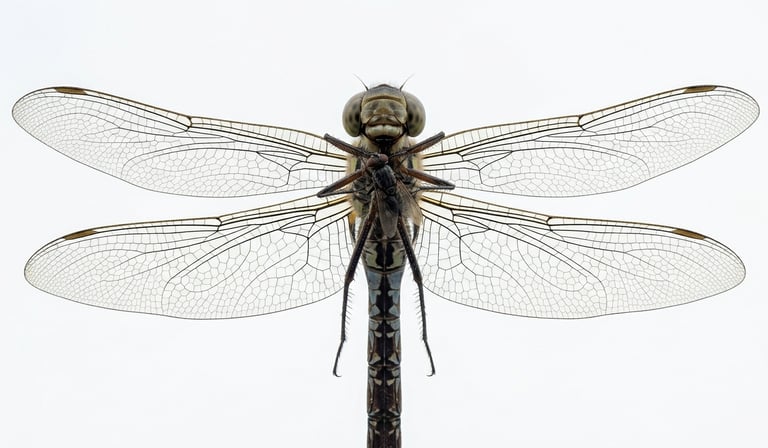
The actual efficiency hierarchy looks nothing like the documentary hierarchy. Dragonflies, which never appear in large-predator coverage, hold the highest confirmed hunting success rate of any animal: 95 to 97%, documented by Rachel Crane at UC Davis and earlier by Stacey Combes at Harvard. African wild dogs, which are covered far less than lions in mainstream wildlife media, succeed on up to 90% of hunts. Lions succeed on 17 to 19% of solo attempts, placing them near the bottom of the large predator efficiency table.
Three Errors, Three Corrections
Error 1: Confusing the biggest predator with the most effective one. Size and efficiency are different variables that often run in opposite directions. Large predators carry proportionally higher metabolic costs, require larger prey to meet their energy needs, and typically face more dangerous prey that fights back. These factors push success rates down. Small predators with high metabolic demands — the black-footed cat needs to consume roughly a fifth of its body weight nightly, according to Luke Hunter at Panthera — are forced to hunt frequently and precisely. Frequent, precise hunting produces high success rates.
Error 2: Treating speed as the primary measure of a killer. The cheetah is the fastest land animal in a sprint, reaching 112 kilometers per hour. It succeeds on 58% of pursuits, per Serengeti field data. The peregrine falcon dives at 320 kilometers per hour, documented by the Natural History Museum, and succeeds on roughly 47% of attempts. The mantis shrimp strikes at 10 to 24 meters per second, accelerating at up to 10,000 times the force of gravity according to Sheila Patek's 2004 Nature paper — the fastest limb movement ever recorded. High speed contributes to predatory success, but it's not a reliable predictor of it. The dragonfly reaches 50 kilometers per hour and succeeds 97% of the time. Hunting success depends far more on strategy and neural processing than on top speed.
Error 3: Treating kill rate as the only ecological metric that matters. A 2025 systematic review in Biological Reviews, led by Luke D. Emerson and Euan G. Ritchie at Deakin University, estimated that pumas generate more than 1.5 million kilograms of carrion daily across the Americas. That figure represents food for scavenger communities ranging from Andean condors to invertebrates — an ecological function entirely separate from the puma's hunting success rate. Orcas, documented in Pitman and Durban's 2012 Marine Mammal Science research, achieve wave-wash success rates of 75% on Antarctic seals, but their deepest ecological impact may be their role in suppressing prey populations across multiple trophic levels. Kill rate and ecological function are related but distinct. The predator that feeds an ecosystem most isn't necessarily the most efficient hunter.
The Full Corrected Ranking
Ranked by confirmed hunting success rate, the top 10 most efficient killers in the animal kingdom are: the dragonfly at 95 to 97%; the African wild dog at up to 90%; the orca, which approaches 100% success on specific prey types; the black-footed cat at 60% with 10 to 14 kills per night; the cheetah at 58%; the mantis shrimp, whose strike speed places it in a category separate from success-rate comparisons; the peregrine falcon at 47%; the great white shark at roughly 50% on seal targets; the tiger at 5 to 50% depending on prey type; and the lion at 17 to 19% hunting solo. The lion has been the dominant figure in wildlife coverage of predators for decades. It ranks last on this list.
The Psychological Enemy: Availability Heuristic
The Availability Heuristic is the tendency to judge the importance or frequency of something based on how easily an example comes to mind. Psychologists Daniel Kahneman and Amos Tversky documented this bias in research beginning in the 1970s. Applied to wildlife, it operates like this: you've seen more footage of lion hunts than of dragonfly predation, so lions feel like better hunters.
They're not. The footage isn't evidence of efficiency. It's evidence of what BBC camera crews can film from a Land Rover.
The corrected mental model doesn't require dismissing charismatic megafauna. Lions, tigers, and great whites are genuinely extraordinary animals. The correction is simpler: those animals are extraordinary for reasons other than hunting efficiency. Lions are extraordinary for their social structure and ability to bring down prey 10 times their size in coordinated group hunts. Tigers are extraordinary for their stealth in dense forest habitat. Great whites are extraordinary for sensory biology that detects prey from hundreds of meters away.
None of that makes them the fastest or most effective killers in the animal kingdom. That distinction belongs to an insect that most people spend summer afternoons swatting away.
The most dangerous predator you'll encounter this year is almost certainly a dragonfly. It'll miss you. Its prey won't.
This is exactly the kind of analysis we publish every week for The Science Impact subscribers, before it reaches mainstream news cycles. Subscribe free. Stay a step ahead.