
One T. Rex Bone Doesn't Rewrite History. Stop Saying It Does.
A single fossil tibia from New Mexico is being used to rewrite T. rex's origins. The evidence doesn't support the claim. Here's what the coverage got wrong.
Paleontology's Single-Bone Problem: We Keep Letting It Slide
One leg bone found in New Mexico is being used to rewrite T. rex's origins. That's not bold science. That's a press cycle feeding on a gap in the fossil record, and the field needs to be more honest about where the evidence actually ends.
A 96-Centimeter Tibia Is Not a Migration Route
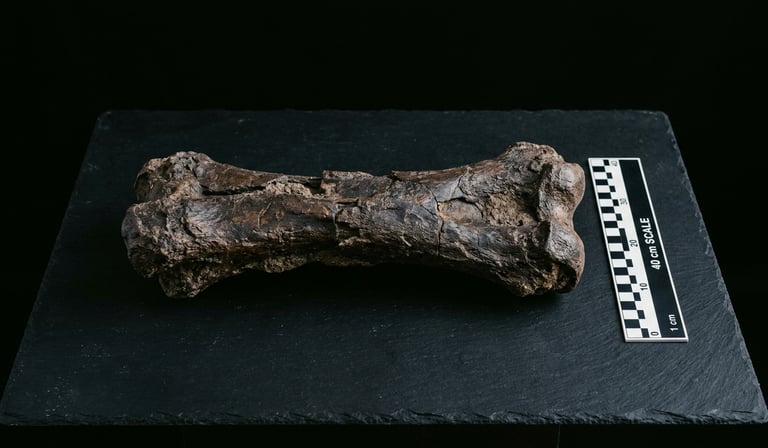
On March 12, 2026, Nick Longrich, a paleontologist at the University of Bath, published a study in Scientific Reports arguing that a large fossil tibia from New Mexico's Kirtland Formation belongs to a tyrannosaurid: the group that includes T. rex and its closest large-bodied relatives. The bone is about 96 centimeters long. Based on its size, Longrich's team estimated the animal weighed approximately 4.5 metric tons, roughly 50 percent more than Albertosaurus, the best-known large tyrannosaur from that time period in North America.
From that single measurement, the study argues that a large-bodied tyrannosaurid was already present in southern North America around 74 million years ago. And from that argument, coverage spun a cleaner story: T. rex may not have migrated from Asia after all. Its ancestors were home-grown, moving northward across the continent before evolving into the apex predator we know.
That's a lot of weight for one shinbone to carry.
The standard explanation for T. rex's origins is well-supported by comparative anatomy: its striking similarity to Tarbosaurus, a tyrannosaurid from what is now Mongolia and China, points toward an Asian origin with a land bridge crossing. Longrich's hypothesis challenges that by placing a large tyrannosaurid in southern North America several million years earlier. The argument is geographically plausible. The evidence base is thin.
Thomas Carr, a paleontologist at Carthage College in Kenosha, Wisconsin, who was not involved in the study, put the problem clearly. He said the tibia could belong to Bistahieversor, a smaller tyrannosaur already documented in that same geological unit, and that the study "has not demonstrated convincingly that the similarities between that tibia and those of tyrannosaurids is not simply the consequence of large size." His point isn't that Longrich is wrong. It's that the data don't rule out the simpler explanation.
That's the null hypothesis. It still stands.
The Press Coverage Ran Ahead of the Science
The reasonable defense of this study is that single specimens drive paleontology forward all the time. The field doesn't have the luxury of large sample sizes. A fossilized creature from 74 million years ago leaves almost nothing behind, and sometimes a single bone is genuinely all we get. Dismissing fragmentary evidence entirely would mean ignoring most of what we know about prehistoric life.
That's fair. I don't dispute it.
But there's a difference between reporting a finding and reporting a conclusion. The finding here is: a large tibia of uncertain species attribution was recovered from the Kirtland Formation and published in Scientific Reports on March 12, 2026. That's verifiable. The conclusion, that T. rex's ancestors migrated northward from southern North America rather than crossing from Asia, requires far more than this bone supports.
Most coverage of this story led with the conclusion. Readers encountered headlines about a T. rex relative and its implications for the dinosaur's origin story. They didn't encounter the specific objection from Carr, the competing hypothesis of Bistahieversor, or the word "disagree" until several paragraphs in, if at all. Science News, to its credit, included the disagreement in its headline. Most outlets didn't.
Science communication that buries the uncertainty isn't neutral reporting. It's a distortion that compounds over time as readers carry the simplified version forward.
What the Field Owes Its Readers
Paleontology has a recurring credibility problem that it created for itself. New species get announced with illustrations, press releases, and media cycles before peer review is complete. Single specimens get assigned genus-level status on morphological features that later analysis sometimes contradicts. The Nanotyrannus debate, still unresolved after decades of study, is the clearest example: a creature either is or isn't a juvenile T. rex, and the field's inability to settle it reflects how difficult species identification from fragmentary remains actually is.
This New Mexico tibia may eventually be confirmed as a tyrannosaurid. Longrich's hypothesis about T. rex's geographic origins may prove correct. More specimens from the Kirtland Formation could settle the question. That would be a genuine advance in understanding one of the most studied organisms in the history of paleontology.
But the scientific community and the journalists who cover it owe readers a clearer accounting of what a single bone can and cannot tell us. The excitement around a T. rex relative is real and earned. The uncertainty around what that bone actually represents is equally real and far less often communicated.
Reporting the finding as a settled discovery, when the researchers who study this group professionally publicly disagree, isn't science communication. It's spectacle with footnotes.
The next time a dinosaur story breaks and the coverage feels clean and definitive, check whether anyone named in the article disagrees. In this case, they did. You almost certainly didn't read that part.
This is the kind of take we publish every week at The Science Impact — positions backed by evidence, not by consensus. Subscribe free. Read science with a sharper eye.