
T. Rex Cousin Found in New Mexico: What the Fossil Shows
A 96cm fossil tibia from New Mexico may belong to a T. rex relative. Scientists disagree. Here's what the bone actually proves and what it doesn't.
T. Rex Had a Cousin in New Mexico. Here's What the Bone Actually Tells Us.
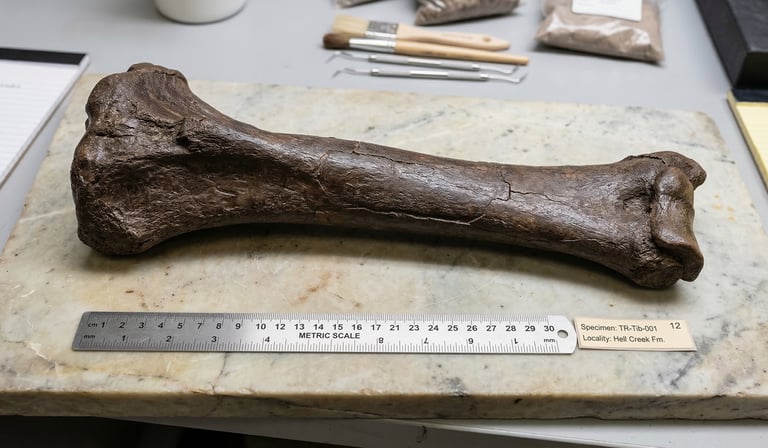
A fossil tibia pulled from New Mexico's Kirtland Formation and stored for decades at the New Mexico Museum of Natural History and Science in Albuquerque is back in the spotlight. On March 12, 2026, Nick Longrich, a paleontologist at the University of Bath, published an analysis in Scientific Reports arguing the bone belonged to a large tyrannosaurid: the group that includes T. rex and its closest heavyset relatives. The tibia measures approximately 96 centimeters long. Based on that size, Longrich's team estimated the animal weighed around 4.5 metric tons.
That figure matters. Albertosaurus, the largest tyrannosaur previously documented from that same period in North America, topped out at roughly 3 metric tons. The New Mexico animal, if the identification holds, was about 50 percent heavier than anything known from that era on this continent. Tyrannosaurids lived between 83 million and 66 million years ago and had been found only in Asia and North America. This bone dates to approximately 74 million years ago, a few million years before T. rex itself appeared.
The Origin Story This Discovery Complicates
Most paleontologists currently favor an Asian origin for T. rex. The dominant hypothesis holds that large-bodied tyrannosaur ancestors crossed a land bridge from Asia into North America, supported by the close anatomical resemblance between T. rex and Tarbosaurus, a tyrannosaurid that lived in what is now Mongolia and China.
Longrich's study challenges that by proposing an alternative: large tyrannosaurids were already present in southern North America well before T. rex emerged, and the lineage may have migrated northward across the continent rather than arriving from Asia. It's a genuine scientific disagreement, and coverage of it has been uneven.
Thomas Carr, a paleontologist at Carthage College in Kenosha, Wisconsin, who was not part of the study, pushed back directly. His position is that the bone could belong to Bistahieversor, a tyrannosaur already known to inhabit that exact geological unit, and that large body size alone doesn't confirm tyrannosaurid membership. The study's identification rests on size and bone shape; Carr argues neither criterion is conclusive from a single specimen.
That dispute isn't a footnote. It's the center of the story, and most headlines missed it entirely.
Read the Fossil Record, Not Just the Headlines
The practical move here isn't to wait for a definitive answer: that may take years of additional fieldwork in the Kirtland Formation. It's to develop the habit of reading paleontology news with one question in your head: how many specimens is this based on?
Single-bone identifications in paleontology are common and sometimes correct. They're also frequently revised. The Nanotyrannus debate, ongoing since the 1980s, turns on whether a specimen is a juvenile T. rex or a separate species. Decades of study, multiple analyses, and still no consensus.
For this specific story, the most reliable source to follow is Scientific Reports, where Longrich's full paper is published under the doi 10.1038/s41598-026-38600-w and is freely accessible. Read the methods section. Note where the researchers acknowledge uncertainty. Then check whether the outlet you read originally mentioned Carr's objection. If it didn't, that outlet is selling you a cleaner story than the science supports.
The Kirtland Formation is an underexplored fossil bed. More bones almost certainly remain. What those bones show when they surface will either support Longrich's hypothesis or quietly bury it. Until then, the correct position is informed uncertainty, not settled conclusion.
A bone that sat in a museum for decades just reopened one of the oldest debates in dinosaur paleontology. That's worth paying attention to, on its own terms, without the false clarity most coverage layered on top.
The SevScience newsletter goes deeper than this, every week. Real analysis. Zero hype. Subscribe free and understand the discoveries before they become dinner-table debates.