
Silverpit Crater Confirmed: The Asteroid Impact That Took 20 Years to Prove
A 2009 scientific vote rejected it. New shocked-mineral evidence proved it. Here's what the Silverpit Crater confirmation actually means for planetary defense.
The North Sea Crater Science Solved in 2002: It Took Two Decades and a Needle-in-a-Haystack Fossil to Close the Case
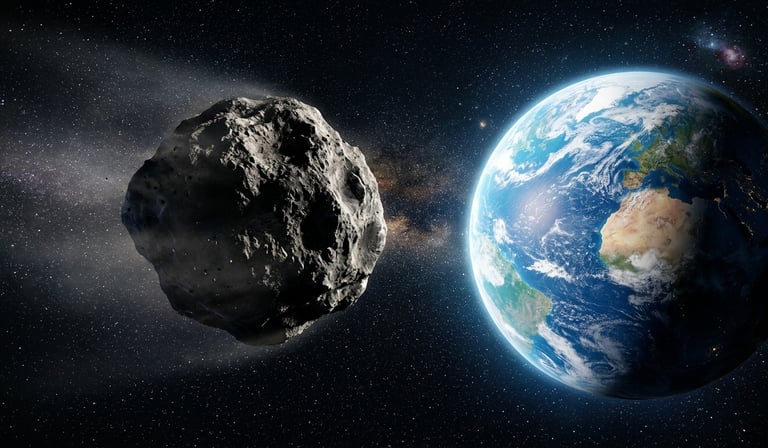
A long-running dispute about the origin of a North Sea crater has finally been settled. Scientists now confirm the Silverpit Crater formed when a roughly 160-meter asteroid struck the seabed about 43 to 46 million years ago. The study was led by Dr. Uisdean Nicholson of Heriot-Watt University and published in the journal Nature Communications, funded by the Natural Environment Research Council.
Silverpit is buried under a huge layer of sediment and was only discovered in 2002, about 130 kilometres off the coast of Yorkshire in the UK. The crater is 3 kilometres wide and surrounded by a series of circular faults spanning 20 kilometres across. For over 20 years, scientists fought over what made it. Salt movement. Volcanic collapse. A space rock. In 2009, geologists put the question to a formal vote and the majority rejected the impact hypothesis. They were wrong.

What Settled the Debate That a Scientific Vote Couldn't
The key was not better imaging alone. Dr. Nicholson's team found rare "shocked" quartz and feldspar crystals at the same depth as the crater floor, recovered from samples taken at an oil well in the area. These minerals don't form from salt movement. They don't form from volcanic activity. They only form under the extreme pressure of an asteroid strike That's the evidence that overturned two decades of scientific skepticism.
Most of the press coverage led with the 330-foot tsunami. That number is vivid and it's real. But it's not the story. The real story is what this discovery demonstrates about how planetary science actually works: slowly, messily, and only when the right physical evidence shows up in the right drill core pulled from the right oil well. Dr. Nicholson described finding the shocked minerals as "a real needle-in-a-haystack effort." That phrase deserves to sit there for a moment. The proof for a 46-million-year-old cosmic impact was sitting inside a petroleum industry core sample. Nobody was looking for it.
Why the Rarity of Underwater Craters Is the Part Worth Tracking
Around 200 confirmed impact craters exist on land, and only about 33 have been identified beneath the ocean. That's not because asteroids prefer dry ground. Oceans cover 71% of Earth's surface, which means most ancient impacts happened at sea and were simply erased. The Earth is such a dynamic planet that plate tectonics and erosion destroy almost all traces of most of these events.
Silverpit survived because it was quickly buried under sediment, protected from the geological processes that scrub craters clean. That preservation is scientifically valuable in a specific, practical way: the more intact craters we can study, the better our computer models get at predicting what a similar impact would do to a modern coastline.
This matters now. By analysing the asteroid's size, composition, and the resulting tsunami, scientists have gained essential insight into how similar events might affect present-day coastlines.
NASA's Planetary Defense Coordination Office uses exactly this kind of historical data to calibrate its impact risk models. Every confirmed crater refines those calculations. Silverpit, thanks to its exceptional preservation, gives researchers something most undersea craters never can: a full sequence of events from initial impact to wave propagation, preserved in rock.


What to Watch Right Now
If planetary defense interests you beyond headlines, the place to follow is NASA's Center for Near Earth Object Studies, which publishes a running table of asteroid close-approach data. Two technology areas directly connected to research like this are also worth watching: seismic imaging systems capable of sub-seafloor resolution, and drill-core mineral analysis tools now used by both the oil industry and planetary geologists. The same technology that found Silverpit's smoking-gun minerals exists because petroleum companies needed to map reservoir rock. That crossover between extractive industry data and impact science is becoming a serious research pipeline.
The more uncomfortable implication of the Silverpit confirmation is this: a 160-meter asteroid created a 100-meter wave. The study also highlights the destructive potential of space objects striking shallow waters, emphasising the importance of monitoring near-Earth asteroids that could pose future threats. A rock that size would be detectable with current technology, but only if we're looking in the right direction. As of this publication, NASA estimates roughly 15,000 "city-killer" sized near-Earth asteroids remain undetected. Silverpit doesn't change that number. It does sharpen the case for why it matters.
The Science Impact newsletter goes deeper than this, every week. Real analysis. Zero hype. Subscribe free and understand the discoveries before they become dinner-table debates.