
Ryugu Asteroid Settles the Origins of Life Debate
Earth didn't bake life from scratch. Asteroid samples prove our genetic building blocks came from space. We must fund cosmic archaeology.
We Must Stop Searching Earth for the Origins of Life: The Ryugu Asteroid Settles the Debate
Biology textbooks have sold us a comfortable fiction for decades. They claim a lightning bolt struck a warm pond billions of years ago. This supposedly sparked the building blocks of biology. That narrative is dead. The Hayabusa2 mission just dropped asteroid dirt into our laps containing all five chemical letters of our genetic code. Earth isn't a miraculous kitchen that baked life from scratch. Our planet was merely a sterile rock that received a cosmic catering delivery. It is time we redirect our origin research toward the void.
The Mathematical Problem With Earth's Kitchen
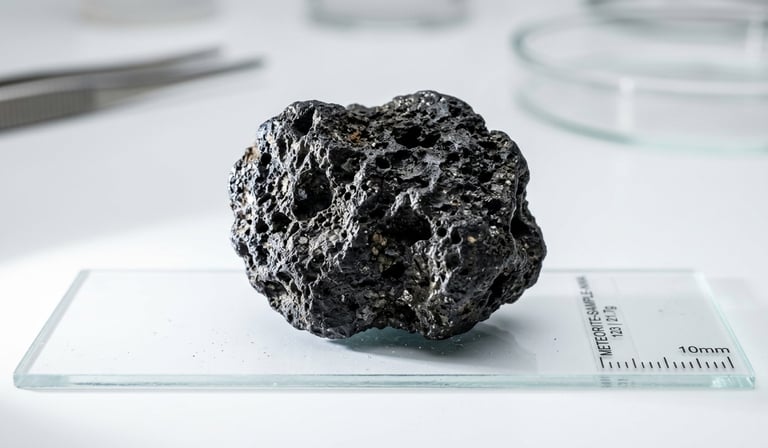
Researchers analyzing the dust retrieved from asteroid Ryugu found every single chemical unit required to build DNA and RNA. We're looking at adenine, guanine, cytosine, thymine, and uracil. The odds of a young volcanic Earth synthesizing these exact five delicate molecules independently are vanishingly small.
Space actually does this chemistry better. The freezing vacuum of the early solar system acted as a massive reactor. Ultraviolet light bathed carbon-rich ice for millions of years to forge these structures. Our genetic alphabet was printed in the dark, long before our planet even had oceans.
Hayabusa2 traveled nearly 200 million miles to bring back a mere 5.4 grams of rock. That tiny sample proved that the void teems with organic potential. The Japanese Aerospace Exploration Agency published findings in Nature Astronomy confirming the pristine nature of these nucleobases. These compounds didn't form after the landing capsule crashed into the Australian outback. True space conditions forged them long before impact.
The Appeal of Terrestrial Exceptionalism
Skeptics in the astrobiology community cling tightly to the idea of a homegrown genesis. They frequently point to the famous 1953 Miller-Urey experiment. That laboratory test zapped a mixture of water and gases with electricity to produce basic amino acids. It remains a brilliant piece of mid-century science.
Proponents argue that simple sparks can easily make amino acids. Advocates assume a boiling planet could certainly assemble nucleic acids. Many worry that outsourcing our origins to asteroids is an intellectual cop-out. Critics think planetary delivery pushes the mystery of how life started one step further out of reach.
That caution makes sense on paper. But it ignores the brutal reality of planetary formation. The early Earth was a molten hellscape constantly bombarded by heavy radiation. Complex genetic molecules would have degraded instantly in those conditions. Ryugu proves these molecules survive beautifully inside the deep freeze of a carbonaceous chondrite asteroid. The rocks were both the delivery vehicles and the protective vaults.
The Budgetary Cost of Looking Inward
I am tired of watching agencies waste billions probing deep ocean vents for chemical miracles that never happened here. The real answers orbit right above us. JAXA proved that asteroid retrieval isn't just an engineering stunt. Sampling remains the only reliable archaeological method for understanding our own cellular makeup.
Governments need to triple the funding for near-Earth object sampling missions immediately. [INTERNAL LINK: space mining economics] The next logical step involves intercepting a pristine comet before it loops too close to the sun. European Space Agency planners already know these iceballs harbor organic secrets.
If we want to know how the first genetic code booted up, we must stop staring at our own boots. We need telescopes and sample return probes. Every dollar spent simulating early Earth chemistry is a dollar stolen from deep space exploration.
Earth didn't invent the alphabet of life; it simply provided a wet place for the letters to arrange themselves.
This is the kind of take we publish every week at The Science Impact: positions backed by evidence, not by consensus. Subscribe free. Read science with a sharper eye.