
The Rules of Off-World Reproduction You Never Learned
space colonization, reproductive technology, status quo bias, minimum viable population, space economics, human survival, off-world habitat
The 3 Rules of Off-World Reproduction Most People Never Learn
Polynesian navigators crossed thousands of miles of empty ocean in wooden outriggers. They did not just rely on the people in the boat to populate new islands. Those explorers carried curated biological cargo to ensure their long-term survival in hostile environments. Interplanetary colonization will require the exact same strategy on a microscopic scale.
The Terracentric Incubation Fallacy
We suffer from a severe cognitive blind spot regarding human expansion into space. Most science fiction conditions us to believe that astronauts will simply pair off and reproduce naturally inside a Martian dome. I call this the Terracentric Incubation Fallacy.
It assumes deep space environments will easily support the fragile mechanics of human pregnancy. Heavy cosmic radiation and fractional gravity are deeply hostile to standard biological reproduction. Relying on natural conception in a tiny, isolated colony practically guarantees a catastrophic genetic bottleneck.
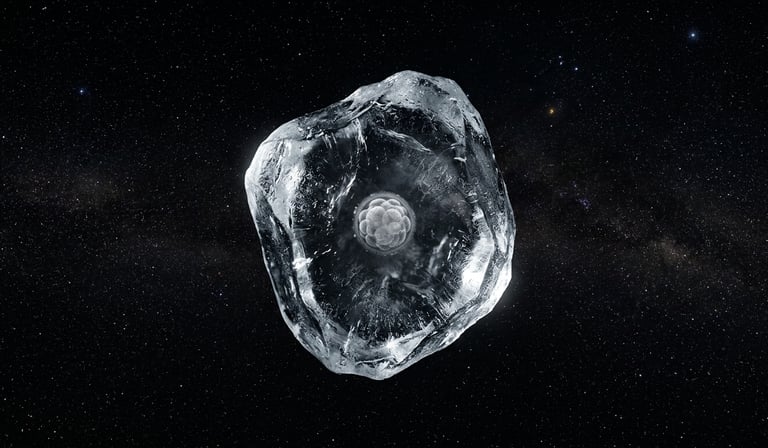
Building a sustainable human presence beyond Earth requires treating genetics as critical infrastructure. Apply this specific mental model when evaluating any deep space colonization timeline:
The diagnostic shift. Stop thinking about colony size in terms of adult humans. Measure viability by the number of unique frozen embryos stored in the habitat manifest.
The practical system. A safe genetic baseline requires an effective population size of at least 500 unique individuals. Transporting that many adults to Mars is currently impossible, but shipping 10,000 cryo-preserved embryos requires minimal cargo space.
How to keep updating this understanding. Monitor the development of rapid, low-mass genetic sequencing. Off-world medical bays need tools that can verify an embryo's chromosomal health in minutes without massive earthly laboratory support.
Confronting the Status Quo Bias
Status Quo Bias tricks our brains into preferring the current state of affairs over any radical change. We naturally want off-world reproduction to look exactly like reproduction on Earth because it feels familiar and safe. That comfort is a dangerous illusion when applied to the vacuum of space.
This psychological trap makes the public deeply uncomfortable with the idea of lab-grown or highly engineered colony expansion. We project our terrestrial ethical norms onto an environment that operates under brutal, unforgiving physics. Publications like the Journal of the British Interplanetary Society have warned for decades that earthly norms will not survive atmospheric exit.
Biology is the hardest cargo to ship.
Clinging to traditional biological models will ground our ambitions permanently. We have to adapt our reproductive strategies to fit the terrifying realities of the cosmos. Advanced rapid genetic screening is the only way we secure a foothold in the dark.
This is exactly the kind of analysis we publish every week for The Science Impact subscribers before it reaches mainstream news cycles. Subscribe free. Stay a step ahead.