
Punch the Monkey Is Making Friends. Here's What That Actually Took.
The internet followed Punch's viral ordeal, but missed what the zoo actually did to help him. Here's the behavioral science behind his recovery.
Punch the Monkey Is Making Friends. What That Actually Took Is the Story Nobody Told.
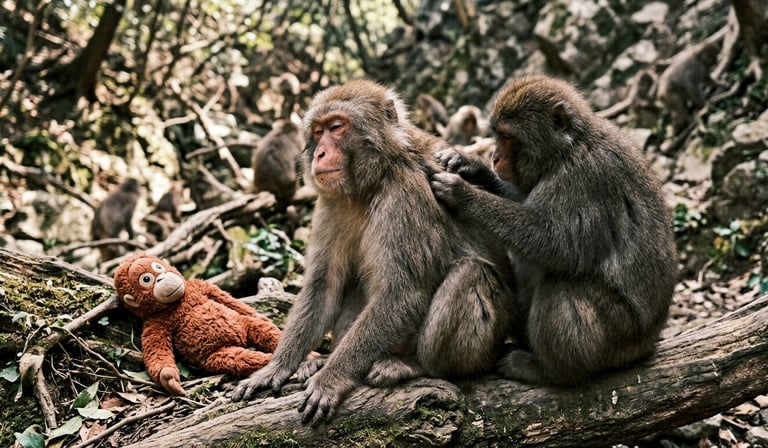
A seven-month-old Japanese macaque named Punch, born July 26, 2025, at Ichikawa City Zoo in Chiba Prefecture, Japan, became a global sensation after videos showed him clutching a stuffed IKEA orangutan for comfort following maternal abandonment. On March 14, 2026, zookeeper Shunpei Miyakoshi confirmed to CNN that Punch was making real progress: he was relying on the plush less, interacting with adult monkeys, and spending more time in play rather than isolation. The zoo's Monkey Mountain enclosure, which houses roughly 60 macaques, had transformed from a source of anxiety for global viewers into something zoo staff have always maintained it was: the right place for Punch to grow up.
Getting to this point involved decisions more deliberate, and more scientifically grounded, than the viral narrative gave the Ichikawa City Zoo credit for.
The "Bullying" Debate Missed the Actual Welfare Risk
The public dispute over whether Punch was being bullied reached its peak in early March 2026, when videos showed him being chased and, in one widely circulated clip, wrestled to the ground by older troop members. The zoo issued a formal statement on March 10 clarifying that Japanese macaques follow a strict hierarchical society in which dominant individuals show disciplining actions toward their subordinates, and that at that time there had been no evidence Punch had been attacked in a way that would threaten his survival.
That framing was accurate. It was also incomplete.
Without his mother to guide him through the troop's strict matrilineal hierarchy, Punch cannot yet read or perform the subordinate signals that lower-ranking Japanese macaques display toward higher-ranking individuals. That's the actual welfare challenge, and it's harder to explain in a video caption than "bullying." A macaque troop assigns rank matrilineally: offspring inherit their mother's social standing, which means Punch entered the group with no rank at all. Every interaction with a higher-status animal is an opportunity to learn those signals. Some of those learning interactions look rough on camera.
The zoo acknowledged that a few high-ranking macaques had demonstrated aggression more frequently, and removed those individuals from the troop on March 8 as a temporary measure. That was a specific, targeted intervention: not a removal of Punch from the troop, but a removal of the outliers whose behavior exceeded normal hierarchical discipline. Primatologists at the Ichikawa City Zoo have been conducting systematic Japanese macaque behavioral research since 1948, and that history shows in how the intervention was calibrated.
The Ichikawa City Zoo's Monkey Mountain had a record-breaking February, with visitor numbers doubling year-over-year and unprecedented queues forming outside the gate. IKEA donated 33 stuffed orangutan toys to Punch in mid-February 2026. The plush toy from their Djungelskog range, originally designed as part of IKEA's wildlife awareness program responding to orangutan habitat loss in Borneo, sold out across the majority of IKEA locations globally. None of that popularity made the reintegration faster or simpler. What actually made it possible was the slow, managed, supervised process of helping an orphaned animal build the social vocabulary he missed by losing his mother.
Follow the Scientists Running This, Not the Petition Campaigns
PETA called for Punch's relocation to a wildlife sanctuary. Other groups launched petition campaigns. Primate experts from the Smithsonian Institution warned that a danger of animals like Punch going viral could be that people want their own monkey, and that Japanese macaques should never be kept as pets and have a right to a Japanese macaque social life.
The most useful thing a reader can do right now is follow the actual science being produced from this case. Alison Behie, primatology expert at Australian National University, has commented specifically on the factors driving maternal rejection in macaques, including first-time motherhood, heat stress during birth, and maternal health prioritization under adverse conditions. Her research group is one of the credible sources for understanding what Punch's early experience predicts about his social development as an adult. The Smithsonian magazine's coverage, drawing on two named primate experts, is the clearest lay-accessible scientific treatment of this case.
What Punch's story actually demonstrates, stripped of the social media narrative, is that modern zoo animal welfare programs can successfully support complex primate development. Punch is not thriving in spite of Ichikawa City Zoo. He's thriving because of a team that understood macaque behavioral science well enough to make the right calls at each stage, from the rolled towels in early care to the tactical removal of specific aggressive animals last week.
That's a story worth following, and the zoo's official updates on X, at @ichikawa_zoo, are the primary source for it.
SevScience newsletter goes deeper than this, every week. Real analysis. Zero hype. Subscribe free and understand the discoveries before they become dinner-table debates.