
Planets Colliding Observed: What It Means for Earth's Moon
Astronomers caught two planets destroying each other 11,000 light-years away. The orbital distance mirrors Earth's — and that changes how we study habitable worlds.
Astronomers Just Watched Two Planets Destroy Each Other. Here's Why That Matters for Earth.
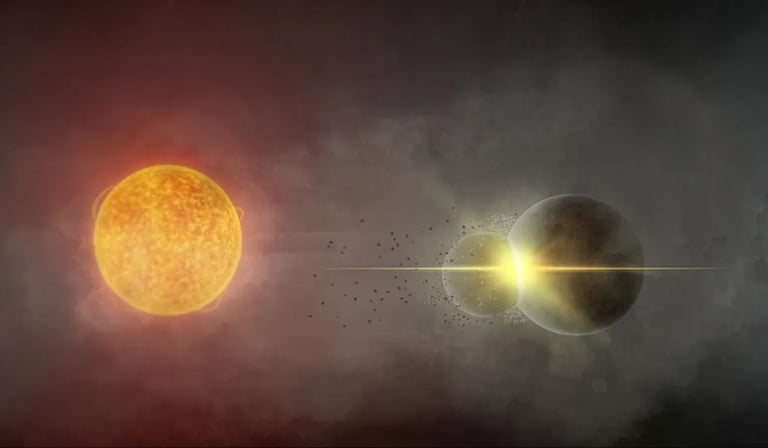
On March 11, 2026, researchers at the University of Washington published a study in The Astrophysical Journal Letters documenting what appears to be a direct observation of two planets colliding around a distant star. The star, called Gaia20ehk, sits roughly 11,000 light-years from Earth near the constellation Puppis. Lead author Anastasios Tzanidakis, a doctoral candidate at the University of Washington, first noticed the anomaly while combing through archival telescope data that included observations from NASA's SPHEREx mission. The findings describe a multi-year sequence of brightness changes consistent with two planets spiraling into a catastrophic impact.
The collision wasn't a single instant. Data shows that around 2016, Gaia20ehk looked like an ordinary, stable star. Then, around 2021, its light dipped three times in quick succession before descending into prolonged chaos. Visible starlight dropped while the system's infrared signal surged sharply: a signature of intensely hot material blocking and radiating around the star. The debris field around Gaia20ehk sits at approximately one astronomical unit from its star, almost exactly the distance at which Earth orbits the Sun. Senior author James Davenport, an assistant research professor of astronomy at the University of Washington, described the event as offering a live window into planetary dynamics that astronomers can normally only model.
The Moon Connection the Headlines Buried
Every news story about this event leads with spectacle. Two planets smashing into each other is viscerally interesting. What most coverage skipped is why astronomers care about this specific collision at this specific orbital distance.
The leading scientific theory for how Earth got its moon is that a roughly Mars-sized body called Theia struck the early Earth approximately 4.5 billion years ago. That impact ejected enough material to coalesce into the Moon. It's a well-supported model, but it rests almost entirely on the physical evidence we have here, in our own system. We've never watched an equivalent event unfold around another star in real time.
Gaia20ehk changes that, at least partially. The one-astronomical-unit orbital radius of the collision debris closely mirrors the Earth-Sun distance, making it the most structurally similar external analog to the Theia impact that astronomers have yet identified. Davenport said the rarity of this event goes directly to the heart of astrobiology: if giant impacts at Earth-like orbital distances are common, then moons like ours may be common too. Moons matter for habitability. They stabilize axial tilt, influence tidal cycles, and likely contributed to the conditions that allowed complex life to develop on Earth. A better statistical picture of how often these collisions happen at the right distances directly informs how we estimate the frequency of habitable worlds.
There are only a handful of documented planetary collisions of any kind on record. None before this one combined the orbital distance, thermal signature, and multi-stage dynamics seen around Gaia20ehk.
What to Follow as the Vera Rubin Observatory Comes Online
Davenport estimates that the Simonyi Survey Telescope at the Vera C. Rubin Observatory, now ramping up operations, could identify roughly 100 new planetary impact events over the next decade. That number, if it holds, would shift the study of planetary collisions from anecdote to statistics. Rubin's ability to survey the entire visible sky every few nights makes it purpose-built for catching slow-moving phenomena that unfold over years rather than seconds.
This is the data pipeline worth tracking. The Vera C. Rubin Observatory maintains a public updates page, and the Tzanidakis-Davenport paper itself is freely available through The Astrophysical Journal Letters at doi.org/10.3847/2041-8213/ae3ddc. Reading the paper's introduction requires no specialized training and gives a cleaner picture of the evidence than any summary can.
For anyone watching exoplanet science, the next two years of Rubin data releases will tell us whether Gaia20ehk is an outlier or the first readable entry in a much larger catalog. That catalog is directly relevant to the question of whether Earth-like conditions are rare accidents or a predictable outcome of how planetary systems evolve.
The collision that made our Moon has haunted planetary science for decades because we couldn't test it against anything else. That's starting to change.
The Science Impact newsletter goes deeper than this, every week. Real analysis. Zero hype. Subscribe free and understand the discoveries before they become dinner-table debates.