
We're Funding Planetary Defense Wrong. Silverpit Proves It.
Detecting asteroids isn't enough if consequence models are undercalibrated. The Silverpit confirmation shows exactly what the funding gap is costing us.
We Keep Funding the Wrong Part of Planetary Defense. The Silverpit Crater Proves It.
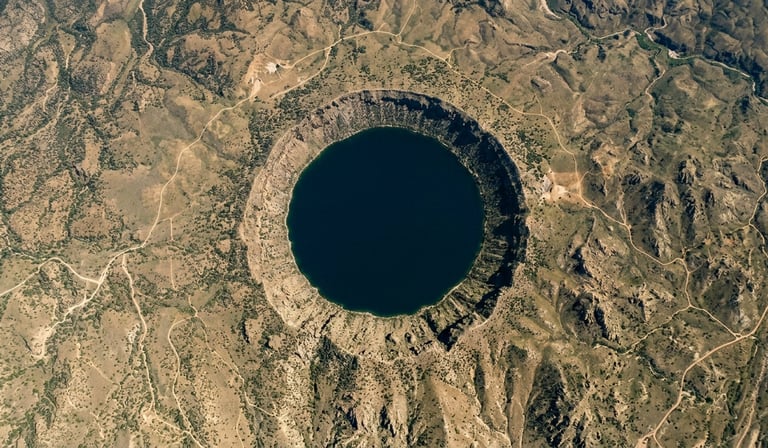
The confirmation of the Silverpit Crater as an asteroid impact site is being covered as a geology story. It isn't. It's an infrastructure story, and the infrastructure lesson it teaches is one that planetary defense agencies have been slow to absorb. We spend billions tracking asteroids we haven't hit yet and a fraction of that understanding the ones we already have. That imbalance is costing us precision we can't get back.
The Detection Budget Dwarfs the Impact Record Budget, and That Ratio Is Wrong
NASA's Planetary Defense Coordination Office received approximately $90 million in fiscal year 2023. The bulk of that funding flows toward telescopes, tracking systems, and deflection research: forward-looking tools aimed at objects that haven't arrived. That's rational as far as it goes. What it systematically underweights is the retrospective science: the painstaking, unglamorous work of confirming, dating, and fully characterizing the craters already sitting in Earth's crust and under its oceans.
The Silverpit case illustrates exactly what that underweighting costs. The crater was discovered in 2002. For more than two decades, its origin was contested. The debate was settled not by a planetary science mission but by Dr. Uisdean Nicholson of Heriot-Watt University, working partly on data collected by a carbon-capture consortium that needed North Sea seafloor surveys for entirely unrelated reasons. The key physical evidence, shocked quartz and feldspar crystals showing pressure signatures of 10 to 13 gigapascals, came from an oil industry drill core that nobody had specifically analyzed for impact markers until Nicholson went looking.
Dr. Nicholson described the search as "a real needle-in-a-haystack effort." That phrase deserves more weight than it's received. The proof that settles a 23-year scientific argument about a significant Earth impact was sitting in a petroleum industry sample archive. Nobody funded a dedicated effort to find it. It was found because one researcher recognized what he was looking at and spent months negotiating access to proprietary data from an energy company.
That is not a success story. That's an accidental success story, which is a different thing entirely.
The Case for Prioritizing Detection Over the Historical Record Sounds Reasonable. It Isn't.
The strongest version of the counterargument runs like this: we can't do anything about past impacts, so why pour resources into studying them when the actionable priority is detecting the next one? Future-focused detection saves lives. Retrospective crater science is academic. Given constrained budgets, forward wins.
It's a coherent position. It's also wrong, and the reason it's wrong is precisely what Silverpit's confirmation adds to planetary science. Studying exceptionally preserved sites like Silverpit is crucial for agencies like NASA's Planetary Defense Coordination Office, helping scientists build accurate computer models to predict wave propagation, coastal devastation, and atmospheric changes should humanity face a similar threat. Those models are not decorative. They're the tools that tell you, after you've detected an incoming object, what its actual consequences will be based on its size, composition, angle, and target terrain.
Detection without accurate consequence modeling produces warnings with error bars wide enough to be functionally useless. Telling a coastal government that an asteroid might hit somewhere in the ocean near them is not actionable intelligence. Telling them the same asteroid, hitting a similar seafloor at a similar angle, would generate a wave between 80 and 120 meters at their shoreline within four hours: that is. Every confirmed impact with a full preserved record narrows those error bars. Only about 33 confirmed impact craters exist beneath the ocean despite oceans covering most of Earth's surface. Each of those 33 is a calibration point. Silverpit is now a high-resolution one.
The "detection over history" argument treats impact science as binary: find the asteroid or don't. Real planetary defense is a chain. You find it, you model it, you warn accurately, you respond. Underfunding any link in that chain doesn't save money. It shifts risk downstream, into the modeling and warning stages, where errors are most dangerous because they happen closest to the event.
Planetary Defense Needs a Dedicated Historical Impact Program Before the Evidence Disappears
The cost of the current approach is concrete. Around 200 confirmed impact craters exist on land, and only about 33 have been identified beneath the ocean. The true number of significant historical impacts is almost certainly far higher, but plate tectonics, erosion, and ocean sedimentation destroy crater evidence faster than it can be found and studied. Every decade without a systematic, funded program to identify and characterize ocean impact structures is a decade of permanent data loss.
The solution isn't complicated. ESA, NASA, and national geological surveys should establish a coordinated program to systematically review existing industrial seismic datasets for unrecognized impact signatures. The datasets already exist. The oil industry has spent decades mapping the seafloor and subsurface for its own purposes, producing archives that represent the most comprehensive subsurface record of Earth's ocean floor ever assembled. Silverpit was identified from a petroleum survey in 2002. Nadir Crater off the coast of West Africa was identified from seismic data collected by the same industry. The next dozen confirmed ocean craters are probably already in those archives, unrecognized.
Funding a formal, sustained program to mine that data would cost a fraction of a single orbital telescope mission. The return, in calibrated consequence models, in understanding of ocean impact dynamics, in preparedness for the next coastal threat, would be proportionally enormous.
Planetary defense that can detect an asteroid but can't accurately predict its consequences isn't defense. It's astronomy with a press office.
This is the kind of take we publish every week at The Science Impact, positions backed by evidence, not by consensus. Subscribe free. Read science with a sharper eye.