
Planet Formation: What the Textbook Gets Wrong
Planets aren't stable endpoints — they're survivors of violent collisions. Here's the mental model that changes how you read every space discovery.
How Planets Actually Form: What the Textbook Version Gets Dangerously Wrong
In 1994, geologist Walter Alvarez stood in a roadside gully near Gubbio, Italy, holding a centimeter-thick layer of clay. That clay separated 65 million years of dinosaur-bearing rock below from a completely different fossil record above. The layer contained iridium concentrations roughly 30 times higher than normal Earth crust. He and his father Luis eventually concluded a six-mile-wide asteroid had struck the planet, ending the Cretaceous period. For most of the scientific community, it took another decade to accept that a single violent collision had reset the entire trajectory of life on Earth.
The same resistance applies, more quietly, to how most people understand planet formation. They picture it as a slow, orderly process: dust becomes pebbles, pebbles become rocks, rocks become planets. Calm, gradual, inevitable. The actual record says something far more violent, and the difference matters.
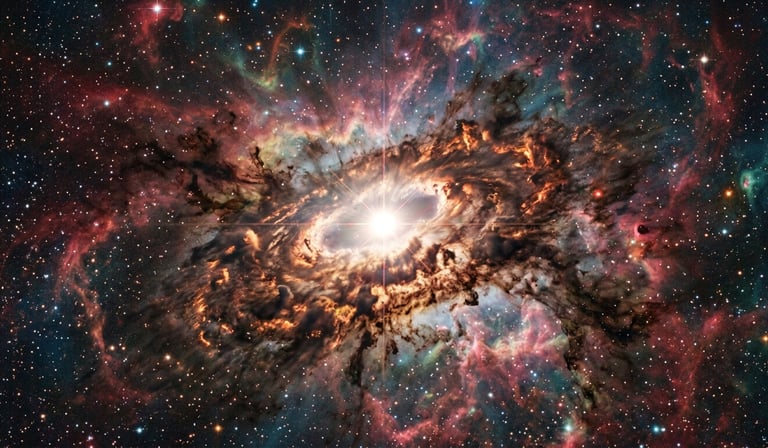
The Stability Illusion: Why "Finished" Solar Systems Don't Exist
There's a perceptual trap in how people read astronomical headlines about planetary collisions. Call it the Stability Illusion: the assumption that planets, once formed, settle into permanent orbits and stay there. Because the solar system looks stable to us now, we assume stability is the natural endpoint of planet formation.
It isn't. It's a lucky snapshot.
Research in orbital dynamics, including work published in Nature in 2011 by researchers at the Southwest Research Institute modeling early solar system evolution, suggests our planetary system went through a period of severe gravitational instability roughly 700 million years after its formation. During that interval, now called the Late Heavy Bombardment, the giant planets Jupiter and Saturn shifted orbits, flinging smaller bodies into chaotic new trajectories. The consequences included intense asteroid impacts on the inner planets and, most significantly, the final architecture of our current system.
The Stability Illusion is grounded in a documented pattern known in behavioral science as Status Quo Bias: people tend to treat the current state of a system as its natural or intended state, and weight evidence of change more heavily than evidence of continuity. When applied to planetary science, this means readers consistently underestimate how violent the past was and how recently, in astronomical terms, things settled down.
A Three-Step Framework for Reading Planet Formation Stories Accurately
Step 1: Stop treating "planet" as a finished product.
Most science communication presents planets as the stable outcome of a process. The accurate framing is that a planet is an object that has survived a period of violent competition. Every rocky planet in the habitable zone of a sun-like star got there by winning a series of collisions, absorbing competitors, and losing others. The Earth without the Moon-forming impact would be a faster-rotating, less tidally stable, probably less biologically hospitable world. Our specific kind of habitability came from violence, not despite it.
Step 2: Use orbital distance as your interpretive lens.
Not all planetary collisions carry equal implications. The collision documented around Gaia20ehk by Anastasios Tzanidakis and James Davenport at the University of Washington matters precisely because it occurred at approximately one astronomical unit from its host star — the same distance at which Earth orbits the Sun. When a collision happens in the equivalent of a star's habitable zone, it tests the giant impact hypothesis for moon formation under real observational conditions rather than computer simulations. The next time you read about a planet collision, the first question worth asking is where it happened relative to its star's habitable zone. That context distinguishes scientifically significant events from geophysically irrelevant ones.
Step 3: Follow the statistics, not the individual event.
Single detections produce headlines. Statistical patterns change science. James Davenport estimates the Vera C. Rubin Observatory could identify roughly 100 new planetary impact events over the next decade. That catalog, once it exists, will let researchers ask frequency questions for the first time: How often do giant impacts occur at Earth-like orbital distances? How often do they produce moon-forming debris fields? Those answers will directly revise estimates of how common habitable worlds are across the galaxy. Check back on Rubin's published survey data every 12 to 18 months. The story being built is slower than a single discovery, and considerably more important.
Novelty Bias: The Reason You Remember the Crash and Miss the Pattern
Novelty Bias is the cognitive tendency to weight new, vivid information more heavily than older, quieter evidence that may be more significant. In plain terms: we're wired to pay attention to dramatic events and underweight patterns.
Planetary collisions trigger Novelty Bias reliably. Two planets destroying each other 11,000 light-years away is visceral and imageable. The quieter, harder-to-visualize fact — that this single observation could eventually help us determine how often Earth-like worlds exist — doesn't produce the same neurological response.
You've experienced this if you read about Gaia20ehk and thought primarily about the spectacle of the collision rather than its implications for astrobiology. That's not a failure of interest. It's the bias doing its job. What it costs you is the ability to assess why one planetary collision story deserves more attention than another, or to know what follow-up data would actually change the scientific picture.
The fix isn't to suppress your response to the dramatic event. It's to add a second step: after the initial reaction, ask what pattern this event belongs to, and whether the research design can actually detect that pattern over time.
Planetary science is in the early stages of building a collision catalog that didn't exist five years ago. The Gaia20ehk event is interesting. What comes after it is the real story.
Most people reading about planets smashing together will move on by tomorrow. The ones who track what the Vera C. Rubin Observatory does with this baseline in the next decade will understand something genuinely new about why Earth ended up the way it did.
This is exactly the kind of analysis we publish every week for The Science Impact subscribers — before it reaches mainstream news cycles. Subscribe free. Stay a step ahead.