
Planet Classification Is Broken. Here's What Replaces It
The rock-or-gas binary has organised exoplanet science for 15 years. A molten sulphur world just broke it — here's the three-step framework for reading what comes next.
Planet Classification Is Broken. Here's How Astronomers Should Think About It Instead.
In 1930, astronomers classified Pluto as the ninth planet in the solar system and left it there for 76 years. The category wasn't wrong, exactly — Pluto is a real object, it orbits the Sun, it's roughly spherical. The problem was that "planet" had been doing too much work for too long, covering objects with fundamentally different formation histories and physical structures. When the Kuiper Belt revealed dozens of Pluto-like objects, the category collapsed under its own ambiguity. The International Astronomical Union reclassified Pluto as a dwarf planet in 2006, not because Pluto changed, but because the simplification had always been inadequate and the evidence finally made that undeniable.
The same pressure is now building on the rock-or-gas binary that astronomers use to classify exoplanets, and the discovery published in Nature Astronomy on March 16, 2026 is the clearest evidence yet that the framework is cracking.
The Consensus Illusion in Exoplanet Science
There's a specific cognitive trap in how both scientists and science readers process classification systems. Call it the Finished Map Fallacy: the belief that a working taxonomy is the same thing as a complete one. It combines the well-documented Illusory Consensus bias, the tendency to overestimate how much agreement exists on a given framework, with a subtler error: assuming that a category which successfully organises current data will successfully organise future data.
Illusory Consensus was first rigorously documented by psychologist Lee Ross and colleagues at Stanford University in a 1977 paper in the Journal of Experimental Social Psychology, describing the tendency to believe that others share your beliefs and judgments more broadly than they actually do. In science communication, it manifests as the reader's assumption that if a framework is used consistently by experts, it must be settled. In exoplanetary science, the rock-or-gas binary has been used consistently because it was the best available shorthand, not because the universe was consulted on whether to comply.
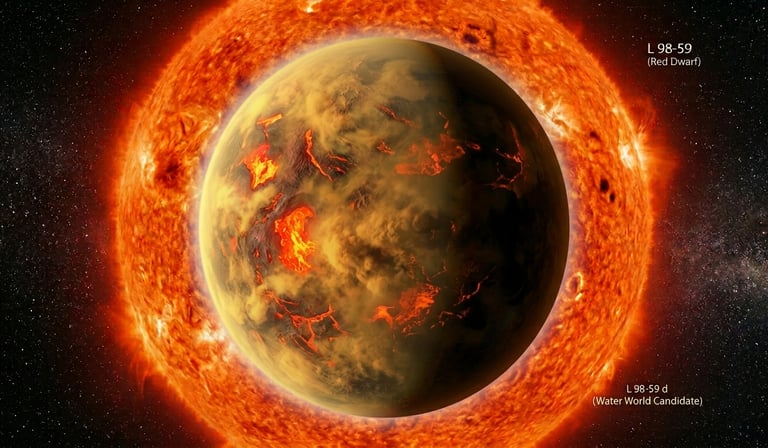
The framework sorts small exoplanets into two buckets: rocky super-Earths with thin or hydrogen-rich atmospheres, and water worlds or gas dwarfs with deep ice or gas envelopes. These categories were derived from solar system analogues and from the first generation of exoplanet data, which was too coarse to detect the nuance that JWST now provides. L 98-59 d fits neither bucket. Its bulk density of roughly 2 grams per cubic centimetre is too low for a purely rocky composition and too high for a water-dominated one. Its atmosphere contains hydrogen sulfide at levels that neither category predicts. The Oxford team's modelling shows it has a permanent magma ocean acting as a chemical buffer between the interior and the atmosphere over five billion years. That's a third category that didn't exist in the framework a week ago.
Three Steps to Reading Planetary Classification Claims More Accurately
Treat any classification system as provisional, not definitional. The distinction matters in practice. A provisional category is a useful shorthand for organising current data, subject to revision when the data improves. A definitional category is one where new observations that don't fit are treated as anomalies to be explained away rather than as signals that the category is wrong. For most of its first decade, exoplanet science operated provisionally. As JWST has delivered finer atmospheric data, some researchers have been treating the rock-or-gas binary more definitionally. The L 98-59 d result is a correction to that drift.
Follow the density-atmosphere pairing, not just the size. The key to understanding what kind of planet you're dealing with is not its radius alone — radius tells you the size of the object, not its composition. The combination of bulk density and atmospheric chemistry is the actual diagnostic. L 98-59 d's density of roughly 2 g/cm³ is a number that any curious reader can use: Earth's is 5.5 g/cm³, and water's is 1.0 g/cm³. A planet well below Earth's density but well above water's, with a sulphur-rich atmosphere, is a chemical fingerprint that points to something neither the gas-dwarf nor the water-world model accommodates. When you read about an exoplanet discovery, looking up the density alongside the size immediately reveals whether the planet is genuinely Earth-like or just Earth-sized.
Watch how the methodology scales, not just the individual result. The durable contribution of the Oxford team's paper isn't the discovery of one unusual world. It's the demonstration that linking JWST atmospheric observations to interior evolution models can reconstruct a planet's geological history across billions of years from a distance of 35 light-years. ESA's Ariel mission, targeted for launch in 2029, is specifically designed to characterise the atmospheres of hundreds of exoplanets. Applied systematically to the Ariel catalogue, the methodology from Nicholls et al. becomes a map of how common molten-mantle planets actually are. That's when the classification question becomes statistically answerable rather than anecdotal.
Illusory Consensus: Why Readers Trust Scientific Frameworks More Than Scientists Do
The Illusory Consensus bias, established in psychology through Ross's 1977 work and extensively replicated since, creates a specific problem for science readers: when experts use the same framework repeatedly without publicly qualifying it, readers interpret that repetition as confirmation that the framework is settled. The rock-or-gas binary appeared in thousands of exoplanet papers and popular science articles over fifteen years. Each appearance without caveat reinforced the reader's mental model of it as fixed and complete.
The scientists using the framework knew it was a simplification. They used it because the data didn't yet justify a more complex one. That gap between the practitioner's implicit understanding of a tool's limits and the public's perception of those same tools as settled truth is one of the most consistent sources of scientific miscommunication in any field.
You didn't misread the coverage of exoplanet science. The coverage genuinely implied a more complete picture than the underlying data supported. The L 98-59 d result is a reminder that maps of the universe, like all maps, are drawn by people working with incomplete information. The accurate relationship to any scientific classification is not confidence but calibrated provisional trust: useful until the data breaks it, at which point the data wins.
The galaxy contains planets that smell of sulphur and have been slowly stirring an ocean of liquid rock for five billion years without cooling. The maps we drew before JWST didn't have room for them. The maps we draw now should.
This is exactly the kind of analysis we publish every week for The Science Impact subscribers — before it reaches mainstream news cycles. Subscribe free. Stay a step ahead.