
Newborn Vitamin K Refusals Nearly Doubled: What Drove It
A JAMA study of 5M+ births shows vitamin K refusals nearly doubled since 2017. Here's the political and medical story behind the numbers.
Newborn Vitamin K Refusals Nearly Doubled in Seven Years. The Science Didn't Change. Something Else Did.
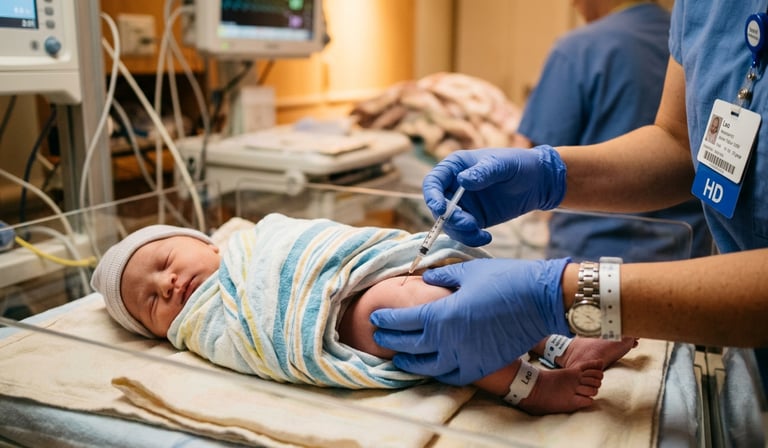
A study published in the Journal of the American Medical Association, which analyzed more than 5 million U.S. births, found that parental refusals of the newborn vitamin K shot nearly doubled between 2017 and 2024, rising from 2.9% to 5.2%. The vitamin K injection is given within hours of birth to prevent vitamin K deficiency bleeding (VKDB): a rare but potentially fatal condition in which newborns bleed internally, most often into the brain or intestines. The American Academy of Pediatrics has recommended the shot since 1961. Nothing in the underlying biology has changed since then.
What changed is the environment these doctors are working in. At a February 2026 meeting of the Idaho chapter of the American Academy of Pediatrics, physicians reported knowing of eight infant deaths from VKDB in the preceding 13 months. These weren't trend lines on a chart. They were eight families.
A Federal Advisory Vote Just Made Every Pediatrician's Job Harder
This is the layer most coverage has underplayed. In late 2025, a federal advisory committee reconstituted under Health Secretary Robert F. Kennedy Jr. voted to end the standing recommendation to give all newborns the hepatitis B vaccine at birth, a policy in place since 1991 that the AAP credits with a 99% reduction in pediatric hepatitis B infections. A federal judge temporarily blocked those decisions in early 2026. But the signal had already left the building.
Pediatricians treating skeptical parents in delivery rooms now contend not just with social media myths but with what looks, from a parent's perspective, like federal-level doubt. Dr. Tom Patterson, president of the Idaho chapter of the AAP and a pediatrician for nearly three decades, describes watching half the newborns on some days leave the hospital without their vitamin K shot. He sometimes has to clarify, patiently, that the injection is not a vaccine.
The three routine preventive treatments are linked in ways that matter. Research cited by the AAP finds that parents who decline vitamin K are much more likely to also refuse the hepatitis B vaccine and erythromycin eye ointment. Doctors across multiple states confirm the pattern: a refusal at birth rarely stops at one intervention.
Each treatment addresses a different, specific threat. Erythromycin ointment, applied within the first hour of life, prevents gonorrheal eye infections contracted during delivery that can cause blindness if untreated. The hepatitis B vaccine prevents a disease that can progress, silently and over years, toward liver failure, liver cancer, or cirrhosis. Neither protection is redundant. A pregnant woman can test negative for gonorrhea or hepatitis B months before delivery and acquire either infection afterward. Any newborn is then exposed.
Eight deaths in 13 months in one state.
Before Your Next Prenatal Appointment: The One Conversation That Changes Everything
If you're expecting, the most useful thing to do before delivery isn't more research. It's a 10-minute conversation with your OB or midwife about all three newborn interventions, by name, before you're in the delivery room. Decisions made in the hours after birth are harder to think through clearly. Decisions made beforehand, with full information and without urgency, tend to be better ones.
When evaluating sources on these interventions, one standard applies: does the source name the study, the journal, and the researcher? Or does it describe a vague risk with no citation? The AAP's published clinical guidance on vitamin K and the CDC's Vitamin K fact sheet are specific, current, and cite the underlying evidence directly. They're free to access. Social media posts are not a substitute.
Pediatricians asking these questions in delivery rooms aren't acting on pharmaceutical pressure. Vitamin K shots, erythromycin ointment, and the hepatitis B vaccine are all inexpensive, off-patent, generic interventions. Nobody profits from their widespread use. The people who profit when parents refuse them are the people selling fear.
The Science Impact newsletter goes deeper than this, every week. Real analysis. Zero hype. Subscribe free and understand the discoveries before they become dinner-table debates.