
NASA's Artemis Restructuring Is Honest. The Plan Wasn't.
NASA just canceled a billion-dollar rocket variant and called it a course correction. The real story is why the original plan was never honest to begin with.
NASA's Artemis Restructuring Is Honest. The Original Plan Was Not.
NASA just admitted, with the quiet confidence of an institution that knows you weren't paying close enough attention, that the Artemis program it sold to Congress and the public for the better part of a decade was never going to work as designed. The February 27 announcement from Administrator Jared Isaacman canceled the Block 1B rocket variant, scrapped Mobile Launcher 2 after roughly $1 billion in construction costs, and converted Artemis III from a lunar landing into an Earth-orbit test flight. That's not a course correction. That's a confession.
The right response isn't outrage. It's recognition. And a harder question: why did it take this long?
The Architecture Was Optimistic by Design, Not Accident
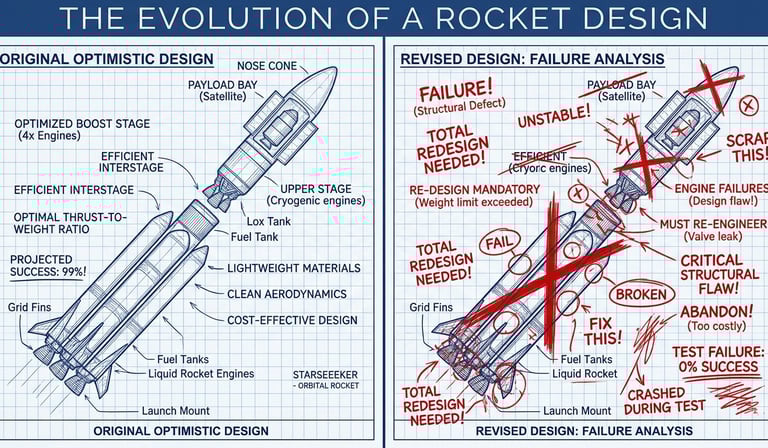
The original Artemis architecture stacked complexity on top of complexity in a way that had no precedent in successful human spaceflight. Each successive mission was supposed to fly on a more powerful rocket variant, dock with a Gateway station that didn't exist yet, use landers still under development, and test life support systems that had already caused delays. NASA Associate Administrator Amit Kshatriya acknowledged this directly on February 27 when he told reporters there was "too much learning left on the table and too much development and production risk" in the original plan.
That is a measured way of describing a program architecture that was politically driven rather than engineering-driven from its earliest stages.
The Space Launch System itself was mandated by Congress in 2010 to preserve Shuttle-era contractor jobs across key congressional districts, a fact documented extensively by the Government Accountability Office and confirmed in multiple NASA Inspector General reports. The Exploration Upper Stage, now canceled, was a technical requirement layered on top of the base SLS to justify its development cost. Mobile Launcher 2, also now canceled, was a $1 billion structure built specifically for a rocket configuration that the agency now says it will never fly. These weren't engineering choices. They were political ones, dressed up in engineering language.
The NASA OIG's March 10, 2026 report assessed the agency's management of moon lander risk and flagged ongoing concerns about schedule realism. That report arrived the same week as the Flight Readiness Review. The pattern has been consistent: independent reviewers identify structural problems, the agency notes the concerns and proceeds, and eventually the structural problems force a public reckoning.
The Counterargument Deserves a Serious Hearing
The strongest defense of the original Artemis architecture runs like this: ambitious programs require ambitious plans. Apollo had its own false starts, redesigns, and tragedies. The shuttle program killed 14 people across two disasters and still produced 30 years of orbital infrastructure. Complexity in spaceflight isn't a bug; it's an unavoidable property of doing things humans have never done before. Canceling the Exploration Upper Stage and restructuring Artemis III isn't a failure of the original plan; it's the plan working as intended, with real-world data replacing preliminary assumptions.
That argument is coherent, and I'd hold it seriously if the original Artemis timeline had been presented with honest uncertainty ranges attached.
It wasn't. NASA publicly targeted a crewed lunar landing for 2024, then 2025, then 2026, then 2028, each time framing the slippage as a manageable refinement rather than evidence of foundational problems. The first crewed Artemis lunar landing is now scheduled for early 2028 at the earliest, and that date carries the same contingent quality as every predecessor. More revealing: the gap between Artemis I in November 2022 and Artemis II in April 2026 will be more than three years. Isaacman's stated goal of ten-month launch cadence, starting now, would require a pace the agency has not demonstrated in a generation. Acknowledging a gap between aspiration and demonstrated capacity is different from endorsing the original aspirations as credible.
What Restructuring Actually Costs, and Who Pays
The fiscal reckoning here is larger than the program changes suggest. SLS currently costs approximately $4 billion per launch, a figure cited by NASA's own budget documents and confirmed in the agency's FY26 budget request. SpaceX's Starship, which may eventually compete for deep space launch services, has a stated cost target orders of magnitude lower, though it hasn't yet carried crew. The restructuring doubles down on SLS as the standard configuration for all future missions while simultaneously acknowledging that the original Block 1B upgrade, which was supposed to make the rocket more cost-competitive, isn't happening.
That's a program that will remain expensive, permanently. And the people absorbing that cost are American taxpayers, not the aerospace contractors whose workforce and facilities the original architecture was partly designed to protect.
The restructuring is still the right call. Flying hardware that's been proven, keeping configuration stable, and adding test missions before attempting landings is precisely what the evidence from Artemis I and II supports. Isaacman is doing what his predecessors didn't: letting engineering drive the schedule instead of the reverse.
But accepting the restructuring as good news requires acknowledging what it follows: years of a program design that served political constituencies as much as mission objectives, funded by a public that was told the Moon landing was on a specific calendar that was never honest.
The lesson isn't that NASA can't go to the Moon. It can. The lesson is that when an agency tells you a complex, multi-year, multi-contractor human spaceflight program will land on the Moon by a specific date, the correct response is not excitement. It's a spreadsheet.
This is the kind of take we publish every week at SevScience — positions backed by evidence, not by consensus. Subscribe free. Read science with a sharper eye.