
NASA Clears Artemis II for April Launch — What the Briefing Left Out
NASA polled "go" for an April 1 Artemis II launch. Here's what the risk briefing didn't say — and why the heat shield debate isn't over.
NASA Cleared Artemis II for April Launch. Here's What the Briefing Didn't Say.
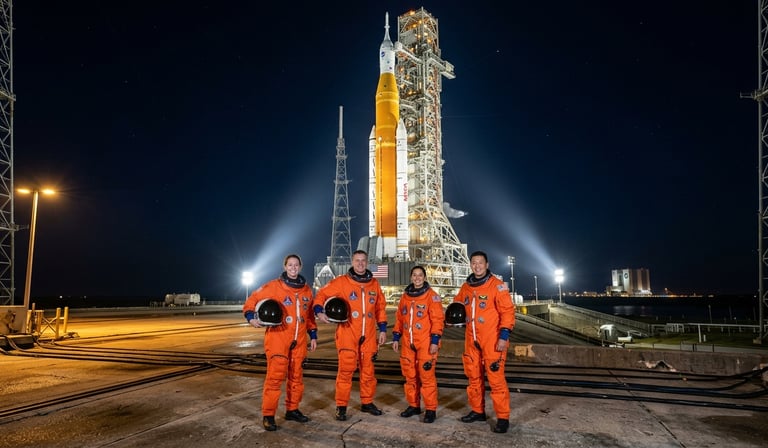
Four astronauts are now three weeks away from riding a rocket around the Moon for the first time since 1972. On March 12, NASA completed its Artemis II Flight Readiness Review and polled unanimous "go" across every team. The target: April 1, 2026, at 6:24 p.m. ET from Kennedy Space Center in Florida, with six backup windows stretching through April 30.
That's the press release version. The briefing itself was more complicated, and more honest, than the headlines suggest.
The Number NASA Refused to Say Out Loud
NASA did not release a specific probability of crew loss for this mission, and the reasoning its own team offered is worth sitting with. John Honeycutt, chair of the Artemis II Mission Management Team, told reporters that such figures "typically involve guesswork" because Artemis II will be only the second-ever crewed flight of the Space Launch System rocket. Before the uncrewed Artemis I test in 2022, NASA calculated a 1-in-125 chance of losing the Orion spacecraft. For this crewed flight, Honeycutt offered no number — only the observation that the odds are probably neither as bad as 1-in-2 nor as good as 1-in-50.
That's a wide range for a human spaceflight mission. Mainstream coverage largely skipped past it.
The heat shield issue deserves more attention than it received. Artemis I's Orion capsule came back from its uncrewed 2022 lunar test with unexpected divots and cracks across its heat shield. NASA spent over a year diagnosing the problem. Artemis II is flying with a nearly identical shield. The fix isn't a redesign; it's a modified reentry trajectory that alters how the capsule slices back into the atmosphere. NASA's inspector general noted last week that the "risk threshold" for lunar mission operations runs roughly 1-in-40. Lori Glaze, acting associate administrator for NASA's Exploration Systems Development Mission Directorate, said the agency has internal consensus that the shield is safe. Several engineers who participated in earlier reviews have publicly continued to object.
Track the Rollout, Not Just the Launch Date
The rocket rolls back out to Launch Complex 39B on March 19. That date matters. Before Artemis II was pushed from February to April, NASA dealt with a liquid hydrogen leak during the first wet dress rehearsal, a valve issue on the Orion hatch, and a helium flow problem in the rocket's upper stage that triggered a full rollback to the Vehicle Assembly Building on February 25. Each of those issues bought a delay. If a new anomaly surfaces after March 19, NASA has until April 6 before the monthly window closes entirely and the mission slips another month.
NASA must launch by April 6 or wait.
If Artemis II launches and succeeds, it's the first human journey to the Moon's vicinity since Apollo 17 in December 1972. The crew — Reid Wiseman, Victor Glover, Christina Koch, and Canadian Space Agency astronaut Jeremy Hansen — would travel roughly 5,000 miles beyond the Moon, farther from Earth than any humans in history. Glover would become the first person of color to reach deep space. Koch would be the first woman. Hansen the first non-American.
Follow NASA's live blog at nasa.gov and Spaceflight Now's coverage for real-time rollout and launch updates. The next two weeks are when this either holds together or doesn't.
SevScience newsletter goes deeper than this, every week. Real analysis. Zero hype. Subscribe free and understand the discoveries before they become dinner-table debates.