
New Molten Planet Found. The Unsolved Question Is Why It's Still Liquid.
Astronomers found a new type of planet with a permanent magma ocean — 5 billion years old and still molten. Here's what the coverage didn't explain.
Astronomers Found a Planet That Doesn't Fit Any Category. The Unsolved Mystery Is Why It's Still Molten.
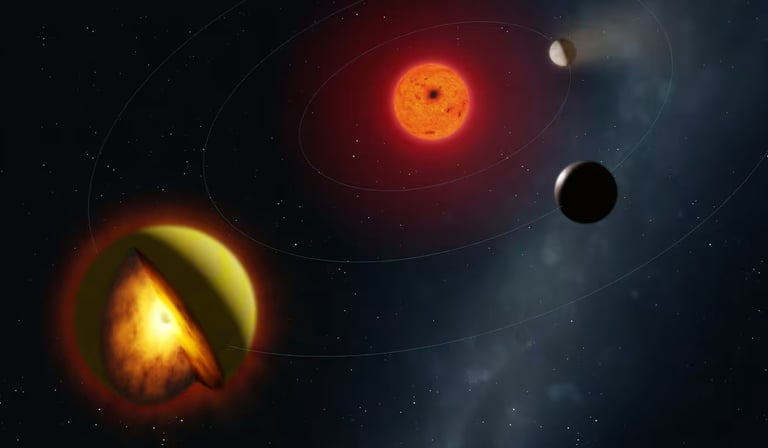
A team led by Dr. Harrison Nicholls at the University of Oxford published findings in Nature Astronomy on March 16, 2026, identifying what they describe as a new class of planet. The exoplanet, designated L 98-59 d, orbits a red dwarf star roughly 35 light-years from Earth and is about 1.6 times the size of our planet. Data from the James Webb Space Telescope and ground-based observatories revealed two things that didn't add up together: the planet has a very low bulk density of roughly 2 grams per cubic centimetre, far below Earth's 5.5, and its atmosphere is laced with hydrogen sulfide. Those two properties put it outside every existing small-planet category.
The Oxford team, working with collaborators from the University of Groningen, the University of Leeds, and ETH Zurich, built computer simulations reconstructing nearly five billion years of the planet's evolution. Their conclusion: L 98-59 d has a mantle of molten silicate, with a global magma ocean extending thousands of kilometres below its surface, acting as a permanent reservoir for sulphur. That sulphur cycles between the interior and the atmosphere over geological timescales, explaining the unusual chemistry JWST detected.
The Question the Coverage Didn't Ask: Why Is It Still Molten After Five Billion Years?
Every major outlet covered the "new type of planet" angle. Almost none paused on the most scientifically interesting detail in the paper: a planet roughly the age of the solar system should not still have a global magma ocean.
Earth formed molten. It cooled. Mars formed molten. It cooled. The expectation for any rocky planet is that its internal heat dissipates over geological time, the magma solidifies, and the planet settles into a layered structure: core, mantle, crust. L 98-59 d is approximately five billion years old, comparable to the Sun, and its mantle remains what lead author Nicholls described as having a viscosity "not like water and not like rock, more like molasses." The Oxford team's paper acknowledges this directly as an open question, suggesting several mechanisms might have kept the interior hot: intense radiation from its host red dwarf, tidal heating from gravitational interactions with sibling planets in the L 98-59 system, or some combination of interior chemistry that has delayed solidification. None of these is fully confirmed.
That unresolved puzzle is the actual frontier of this result. The existence of a sulphurous magma-ocean world is striking. The fact that it's stayed molten for five billion years potentially tells us something new about how planets retain heat at geological timescales that no existing model cleanly explains.
Co-author Professor Raymond Pierrehumbert, also of Oxford's Department of Physics, noted that computer models can now reconstruct the hidden interior of a planet we will never visit, using only atmospheric chemistry and density measurements. That methodology is the durable contribution here: linking what JWST can observe at a distance to what's happening thousands of kilometres beneath a planet's surface. Applied to the full JWST catalogue, it's a tool for finding how many other planets fall outside the rock-or-gas binary, a question the team stated it plans to pursue using machine learning on incoming data from the upcoming Ariel and PLATO missions.
The Planet Classification Problem Has Consequences for the Search for Habitable Worlds
This matters beyond the single discovery because the rock-or-gas binary shapes how astronomers prioritize planets for habitability studies. A planet that appears to be a rocky super-Earth gets put on the shortlist for follow-up atmospheric observations seeking signs of life. A planet like L 98-59 d, which would have been classified as either a gas dwarf or a water world under the old framework, would have had its actual nature misread.
The L 98-59 system has three known planets, and the system has been extensively studied. L 98-59 b and L 98-59 c were flagged as potentially interesting targets precisely because they're small and rocky in a nearby system. This discovery updates the picture of what small, low-density planets can actually be, and it changes the interpretive framework for every similar planet already in the catalogue.
Follow the JWST observation schedule for the L 98-59 system, and watch for results from the Ariel mission, which ESA expects to launch in 2029 with atmospheric characterisation of nearby exoplanets as its primary objective. The methodology developed by the Nicholls et al. team is what Ariel data will be fed into. That's where the next members of this new planet class will be identified.
A world covered in a permanent ocean of molten rock, smelling of hydrogen sulfide, apparently suspended in a state it should have outgrown billions of years ago, sits 35 light-years away and was only just recognised for what it is. The galaxy's inventory of planet types just got longer.