
Magnetar Born Inside Supernova: The Spacetime Physics Explained
200-day supernova observation just confirmed a 16-year-old magnetar theory. Here's the general relativity nobody explained.
The Spacetime Physics Nobody Explained
In December 2024, a network of 27 robotic telescopes locked onto a dying star about a billion light-years from Earth. What followed was a 200-day observation campaign that has now delivered something astrophysics has chased for 16 years: direct evidence that a magnetar forms inside a superluminous supernova and drives its extraordinary brightness.
The research, led by Joseph Farah of UC Santa Barbara and Las Cumbres Observatory, was published on March 11, 2026 in the journal Nature. The supernova, designated SN 2024afav, produced four rhythmic brightness pulses with progressively shorter intervals after its peak. The team calls this pattern a "chirp." It can only be explained, according to the paper, by Lense-Thirring precession, a general relativistic effect in which a spinning mass drags spacetime around itself like a slow vortex.
General Relativity Just Became a Telescope. That's What Coverage Missed.
Most headlines called this a magnetar detection. That's accurate and incomplete. What actually happened is that the team used spacetime distortion as a precision measurement instrument inside an opaque explosion.
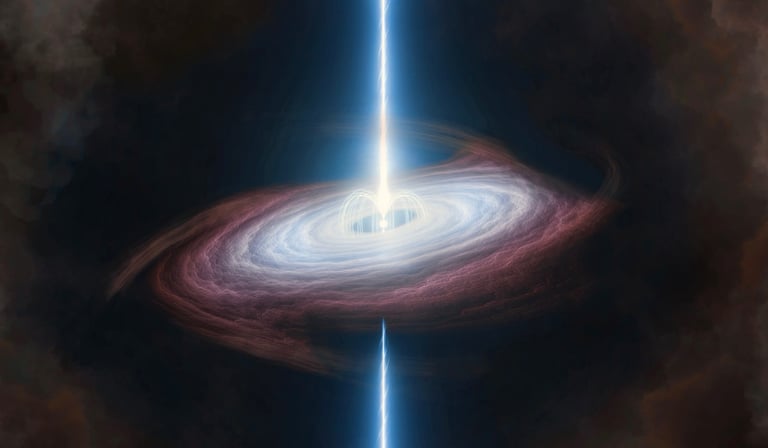
Here's the mechanism. When SN 2024afav's core collapsed, infalling debris formed an accretion disk around the newborn magnetar. That disk wasn't aligned with the magnetar's spin axis. Because Einstein's general relativity predicts that a spinning mass warps the spacetime around it, the magnetar's rotation forced the misaligned disk into a wobble. The wobbling disk periodically blocked and reflected the magnetar's energy output, producing the four-bump chirp pattern.
The team didn't just detect a magnetar's existence. They read its internal mechanics through a billion light-years of debris. That distinction matters beyond this one star.
Lense-Thirring precession has been confirmed near Earth using satellites, but applying it to stellar remnants opens a new method for probing neutron star interiors without direct line of sight. You're using spacetime geometry as a diagnostic tool. That technique doesn't stay confined to one paper once it works.
This also closes a specific, long-standing argument. In 2010, UC Berkeley theoretical astrophysicist Dan Kasen, along with Lars Bildsten and Stanford Woosley of UC Santa Cruz, proposed that magnetars were the hidden engines behind superluminous supernovae, the class of stellar explosions that outshine ordinary supernovae by a factor of 10 or more. The model was plausible for 16 years. SN 2024afav is the first direct confirmation it's correct.
"For years the magnetar idea has felt almost like a theorist's magic trick," Kasen said. The chirp, he noted, is what pulled back the curtain.
Track Las Cumbres Observatory: It's Built for Exactly This Kind of Science
If you follow astrophysics at all, Las Cumbres Observatory is worth understanding as an infrastructure story, not just a telescope story. Its global network of 27 robotic telescopes is designed to produce continuous light curves on transient events that no single facility could monitor without gaps.
The four-bump chirp in SN 2024afav required persistent multi-month tracking. Weather disrupts single-site campaigns. Daylight creates coverage gaps. Las Cumbres was built specifically around the insight that transient cosmic events don't respect observatory schedules. You can follow its ongoing survey work at lco.global.
For readers interested in physics and instrumentation specifically, this is also a story about methodology. The detection relied not on a larger mirror or a more sensitive sensor but on distributed, patient observation combined with a theoretical model precise enough to predict a very specific signal shape.
It's the kind of science that doesn't get coverage proportional to its significance.
Farah will move to UC Berkeley this fall as a Miller Postdoctoral Fellow in Kasen's group. That means the team behind this paper will continue operating in the same institution, with access to the same observational infrastructure.
The Science Impact newsletter goes deeper than this, every week. Real analysis. Zero hype. Subscribe free and understand the discoveries before they become dinner-table debates.