
Why Saving Every Wild Animal Harms the Environment
Wildlife management requires uncomfortable choices. Learn why protecting invasive megafauna permanently damages native ecosystems and water resources.
Why Prioritizing Charismatic Wildlife Destroys Ecosystems and What the Science Actually Shows
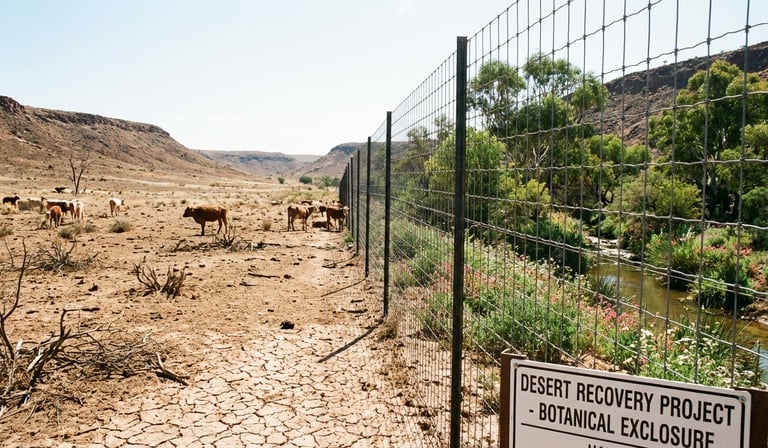
Federal agencies spend millions of dollars annually removing wild horses and burros from fragile American deserts. Public outrage follows every single helicopter gather. People see a majestic animal losing its freedom and immediately donate to legal defense funds to stop the operations. The soil crusts, native amphibians, and perennial grasses dying under the weight of overpopulation have no public relations team.
The megafauna empathy blindspot
Human beings evaluate ecological health through a deeply flawed lens. We look for large, familiar mammals. If a landscape contains herds of grazing animals, our instincts tell us the environment is thriving. Wildlife biologists measure success through entirely different metrics. They look at insect biodiversity, groundwater retention, and native plant regeneration.
This divergence in perception creates a massive conflict in modern conservation. Citizens demand absolute protection for individual animals. Ecologists demand protection for the interconnected systems that keep those animals alive. A feral burro in the Sonoran Desert acts as a biological bulldozer. It crushes the nesting sites of the Sonoran desert tortoise. The animal also consumes the exact forage required by native bighorn sheep. Protecting the invasive burro guarantees the slow starvation of the native species. Our empathy for the individual mammal blinds us to the collapse of the habitat.
Researchers at the United States Geological Survey have documented this exact dynamic across the western states. Their field studies confirm that sensitive riparian zones degrade rapidly when unmanaged grazing populations increase. We prioritize the animals we can pet or photograph. Society ignores the foundational species that actually hold the biome together.
True conservation requires choosing which species gets to eat.
The trophic accounting system
Managing public lands requires moving past emotional reactions and adopting a rigorous biological framework. You can evaluate any wildlife management policy by applying a three-step model.
Step 1 involves dropping the assumption that human non-interference is always the best policy. Introduced species like wild pigs in Texas or feral burros in Arizona don't have natural predators capable of controlling their numbers. Mountain lions can't eat enough burros to stabilize a herd that doubles its population every four years. Failing to intervene is an active choice to let the invasive species consume the landscape.
Step 2 requires calculating the aggregate biological cost of overpopulation. The International Union for Conservation of Nature provides clear metrics for assessing habitat degradation. You must apply these metrics rigorously. The Bureau of Land Management estimates that wild horse and burro populations on western public lands exceed 80,000 animals. The scientifically determined carrying capacity for those specific ranges is just under 27,000. A herd of 200 burros might exist sustainably within a watershed. Expanding that population to 2,000 will permanently destroy the water supply. You must weigh the welfare of the overpopulated mammal against the survival of the entire local food web.
Step 3 establishes active management as a permanent necessity. Ecosystems altered by human development will never return to a pristine historical baseline. Wildlife agencies must continuously cull, relocate, or chemically sterilize populations to maintain a synthetic balance. This process represents basic ecological triage. The 2026 removal operations in the Lake Pleasant region perfectly illustrate this harsh reality. The land simply can't support the biomass.
The appeal to nature
This specific cognitive error derails countless environmental initiatives. The appeal to nature is a logical fallacy where people assume that anything perceived as natural must be inherently good, safe, or optimal.
When citizens protest wildlife management operations, they often argue that nature should simply take its course. They view federal intervention as an artificial disruption of a peaceful wilderness. That perspective ignores the hard scientific truth. Human actions already shattered the natural baseline centuries ago. We introduced the feral grazers. Settlers eradicated the apex predators. Modern infrastructure fragmented the migration corridors with highways and concrete canals.
Conservationists working with the Arizona Game and Fish Department face this fallacy during every public comment period. Well-meaning advocates demand that agencies stop using helicopters or contraceptive darts. They suggest letting the animals regulate their own numbers. Self-regulation in biology simply means mass starvation during the next drought. It is a brutal, agonizing process that ruins the soil for decades.
Allowing nature to take its course in a heavily modified environment doesn't restore balance. It accelerates ecological collapse. The starving deer and barren dirt left behind by unmanaged overgrazing are perfectly natural outcomes. They are also entirely avoidable disasters. Expecting a damaged ecosystem to heal itself without intervention is a dangerous form of magical thinking. Effective land management demands heavy, sustained human interference. You cannot save the desert by refusing to manage it.
This is exactly the kind of analysis we publish every week for The Science Impact subscribers, before it reaches mainstream news cycles. Subscribe free. Stay a step ahead.