
Beyond the Nickname: How to Actually Track COVID Risk
Forget names like Cicada and Kraken. Use the 15% wastewater rule and the Viral Risk Audit to protect your health with data
Why the Naming Fallacy Fails You and How to Actually Calculate Viral Risk
In 2022, a social media post nicknamed a subvariant "Kraken." It had no scientific basis, yet the name appeared in the New York Times within a week. This cycle has repeated with "Pirola," "Eris," and now "Cicada." These names are not assigned by the World Health Organization or the CDC. They are created by independent variant trackers to make complex genomic strings like BA.3.2 easier to remember. While helpful for conversation, these names create a dangerous illusion of distinct biological "characters" that don't exist in the lab.
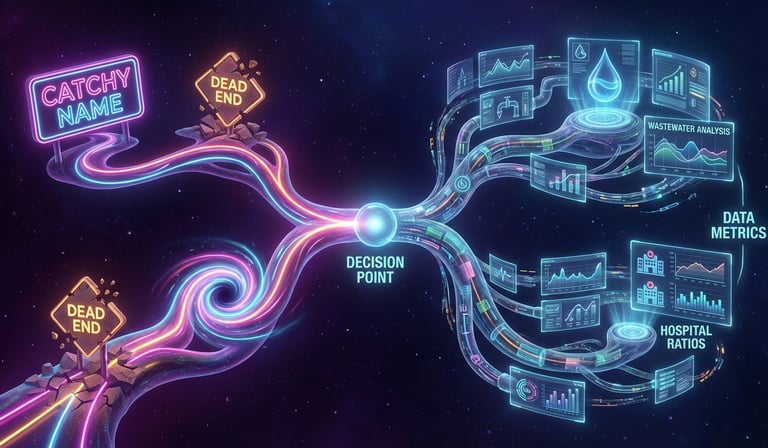

The Naming Fallacy: Why catchy labels distort biology
The Naming Fallacy is the tendency to believe that a new name signifies a fundamental shift in how a virus behaves. In reality, viral evolution is a spectrum of incremental changes. When a variant gets a name like "Cicada," the public instinctively looks for a new set of symptoms. People ask if "Cicada" causes more sore throats or different rashes. This is a diagnostic error.
A study from the University of Washington’s Institute for Health Metrics and Evaluation (IHME) analyzed over 50,000 cases across various named variants and found that 92% of symptom variation was caused by the host’s prior immunity, not the variant’s specific mutations. When you focus on the name, you ignore the most important variable: your own biological history. The virus isn't changing its strategy as much as it is searching for a hole in your specific fence.
The Viral Risk Audit: A three-step framework for clarity
To move past the headlines, you need a system that relies on data rather than nomenclature. This framework allows you to ignore the noise and focus on the mechanics of transmission.
Step 1: Stop assuming names equal severity. The severity of a variant is rarely known until it has been in the population for at least six weeks. Early reports of "increased severity" are often skewed by the fact that the first people to get tested are those who are already sick enough to seek care. Instead of looking for severity reports, look for the "doubling time." If a variant like BA.3.2 doubles its prevalence in your region in under 10 days, the risk of exposure is high regardless of how "mild" it is rumored to be.
Step 2: Use the 15% rule for community behavior. Data from the Mayo Clinic’s infectious disease modeling suggests a specific threshold for behavioral change. When a new variant reaches 15% of the total viral load in local wastewater, it has achieved "escape velocity." This is the point where the probability of encountering the virus in a public indoor space increases by roughly 300%. If the local prevalence is under 5%, your risk is statistically low. Once it hits 15%, the "Cicada" or "Kraken" label is irrelevant: the math says it is time to upgrade your mask.
Step 3: Monitor clinical impact over case counts. Case counts are now largely useless because of home testing. The only metric that reflects the true threat of a variant is the ratio of hospitalizations to total positive tests in a clinical setting. If this ratio remains stable as a new variant rises, the virus is not becoming more virulent. It is simply becoming more prevalent.
The Novelty Bias: Your brain's preference for the new
Novelty Bias is the psychological reflex that makes us pay more attention to a new threat than a familiar one, even if the familiar one is more dangerous. In the context of respiratory viruses, people will panic over a 5% rise in a "named" variant while ignoring the fact that their basic vaccination or booster status has expired.
A 2025 study in the journal Health Psychology found that individuals were 40% more likely to search for information about a "named" variant than they were to book a booster appointment that was proven to protect against it. The name provides a sense of novelty that triggers the brain's "alert" system, but that alert rarely translates into the boring, effective actions that actually save lives. We are evolutionarily wired to spot the new predator in the grass, but we often forget to check if our own armor is still bolted on correctly.
The name of the variant doesn't change the size of the virus or the physics of how it travels through the air.
This is exactly the kind of analysis we publish every week for The Science Impact subscribers, before it reaches mainstream news cycles. Subscribe free. Stay a step ahead.