
How to Read Asteroid Risk Science Without Being Misled
Expert votes, dramatic comparisons, and gaps in coverage all distort how we think about asteroid impact risk. Here's the framework that cuts through it.
Why Asteroid Threats Are Harder to Assess Than Scientists Admit: A Guide to Reading Impact Risk Without Panic or Delusion
Start with a vote. In 2009, a room of professional geologists examined the Silverpit structure, weighed the available evidence, and voted. The majority concluded it was not an asteroid crater. They were wrong. That vote is not a story about incompetent scientists. It's a story about a cognitive failure that affects every field where risk is invisible, evidence is incomplete, and the consequences of being wrong are delayed by millions of years.
The Consensus Trap: Why Expert Agreement Is Not the Same as Scientific Truth
The specific cognitive trap at work in the Silverpit case has a documented name in decision science: authority bias, the tendency to defer to the collective opinion of credentialed peers rather than evaluate the underlying evidence independently. A majority of geologists voted against the impact crater hypothesis in 2009. That vote held scientific sway for over 15 years. It wasn't overturned by a new argument. It was overturned by a physical object: a set of shocked quartz crystals pulled from an oil-industry drill core that nobody had specifically looked for.
This pattern repeats across the history of geology. Continental drift was voted down for decades before physical evidence made denial impossible. Helicobacter pylori as a cause of ulcers was dismissed for years before Barry Marshall drank a petri dish of the bacteria to prove his point. The mechanism is always the same: institutional consensus becomes a load-bearing wall in scientific culture, and dismantling it requires evidence so physical and undeniable that no vote can contain it.
The trap here isn't stupidity. It's the rational short-term behavior of people working inside systems that punish heterodox claims and reward consensus.
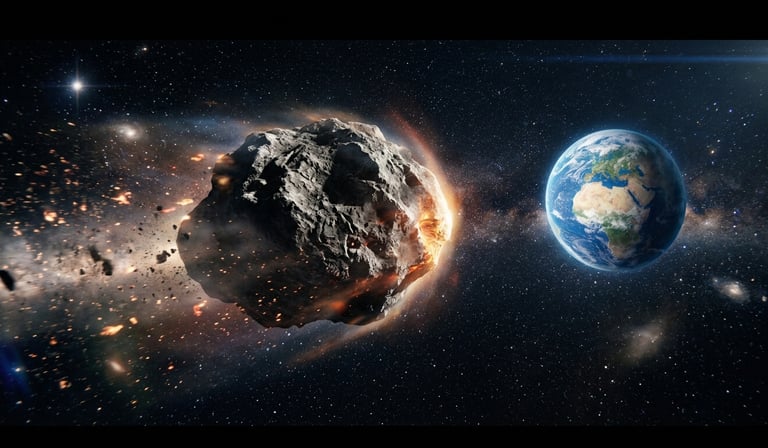

A Three-Step Framework for Reading Impact Science Without Being Manipulated by It
The Silverpit case teaches a repeatable framework for evaluating any science story that involves expert disagreement, long time horizons, and dramatic physical consequences.
Step 1: Identify what kind of evidence is actually settling the argument. In impact science, the gold standard is shocked minerals, specifically quartz and feldspar crystals that develop a planar deformation fabric impossible to produce outside of hypervelocity impact conditions. When you read a science headline, ask what physical evidence is on the table. Expert agreement is not evidence. Computer models are not evidence. Shocked minerals found at the exact depth of a crater floor? That's evidence.
Step 2: Apply a rarity adjustment before you assess the risk. Only about 33 impact craters have been identified beneath the ocean, despite oceans covering most of Earth's surface. That's not because ocean impacts are rare. It's because the evidence gets destroyed. When a physical finding survives for 46 million years in a dynamic, erosive environment, it's telling you something about preservation conditions, not about impact frequency. Don't mistake survival bias for low probability. The craters you don't see are the informative ones.
Step 3: Follow the modeling, not the metaphor. Coverage of Silverpit fixated on comparisons to Big Ben and the Statue of Liberty. Those comparisons are useful for scale. They're useless for risk. What actually matters is the computer modeling being fed by this kind of confirmed impact data. Studying exceptionally preserved sites like Silverpit is crucial for space agencies like NASA's Planetary Defense Coordination Office, helping scientists build highly accurate computer models to predict wave propagation, coastal devastation, and atmospheric changes. Over Here Toronto Track the models. The metaphors are for the press release.
The Availability Heuristic Is Distorting How You Think About Asteroid Risk
The availability heuristic is a documented cognitive shortcut: you assess the probability of an event based on how easily examples come to mind, not based on actual frequency data. Asteroid coverage spikes when a discovery is confirmed, a near-miss is tracked, or a spectacular anniversary runs. That spike makes the risk feel elevated. The long silences between these spikes make the risk feel absent.
Neither perception is accurate. The real frequency is being estimated right now by planetary defense teams using exactly the kind of confirmed crater data that Silverpit has just added to the database. Identifying the asteroid's metallic and rocky components is critical to evaluating impact severity and coastal vulnerability, reinforcing the need for continued observation of near-Earth objects.
The problem with the availability heuristic in this context is asymmetric. Overestimating asteroid risk leads to anxious news consumption and not much else. Underestimating it because nothing has happened recently is how you end up chronically underfunding the detection infrastructure that would actually give us warning time. The rational response to this research is not fear and it's not dismissal. It's a quiet insistence that the institutions doing impact monitoring receive consistent resources regardless of whether a headline is currently running.
That distinction, between evidence-based concern and availability-driven panic, is the one that matters. It doesn't make good copy. It does make for better decisions.
This is exactly the kind of analysis we publish every week for The Science Impact subscribers, before it reaches mainstream news cycles. Subscribe free. Stay a step ahead.