
How to Read a Fossil Discovery Without Being Misled
Paleontology headlines look certain. The science rarely is. Here's the three-step framework for evaluating fossil claims before you repeat them.
What Paleontologists Actually Know from a Single Bone
In 1676, a British naturalist named Robert Plot examined a large fossilized femur found in Oxfordshire and concluded it belonged to a giant human. He was wrong by about 165 million years: the bone came from a Megalosaurus, one of the first dinosaurs ever described. Plot had no framework for what he was looking at, so he mapped the evidence onto the largest creature his world could accommodate.
The tools have improved. The instinct hasn't always.
The Reconstruction Illusion: Why We See More Than the Bone Shows
Every time a new dinosaur fossil makes headlines, readers encounter full-color reconstructions, named species, estimated body masses, and behavioral inferences. The images are vivid. The certainty feels earned. What most coverage never explains is how much interpretive distance separates a fragment of mineralized bone from the confident creature depicted beside it.
Call this the Reconstruction Illusion: the cognitive tendency to treat a visual or narrative representation of a fossil as if it carries the same evidential weight as the bone itself. It's a specific form of what psychologists call Illusory Consensus, first described by Lee Ross at Stanford University in 1977: the assumption that others share your level of certainty about something, when in fact that certainty was never established in the first place. Applied to paleontology, it shows up as readers accepting species identifications, migration hypotheses, and behavioral claims as settled when the underlying evidence is fragmentary and actively disputed among the scientists who study it.
The New Mexico tibia published in Scientific Reports on March 12, 2026 is a direct example. Two credentialed paleontologists looked at the same bone and reached different conclusions about what animal it came from. That's not a failure of science: it's how fragmentary evidence works. The failure is in coverage that presents one interpretation as the finding rather than as one position in an ongoing argument.
How to Evaluate a Fossil Claim in Three Steps
The gap between a bone and a conclusion is bridgeable, but it requires a specific reading strategy. Here's the framework.
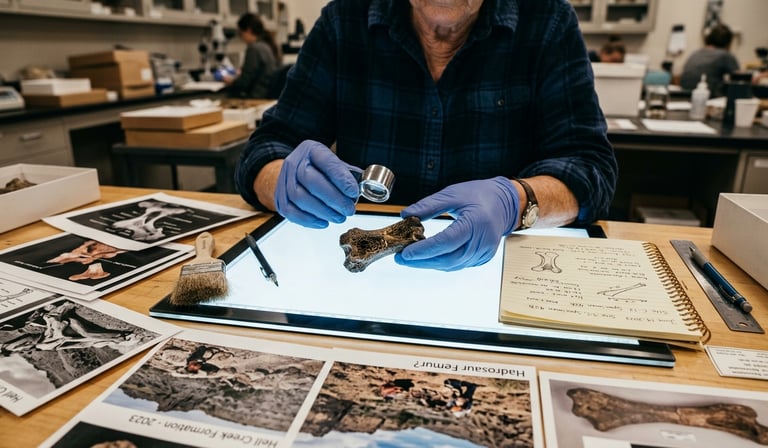
Step 1: Identify what was physically recovered versus what was inferred. In the New Mexico case, the physical recovery is a single tibia measuring approximately 96 centimeters, dated to roughly 74 million years ago. Everything else: the species attribution, the estimated 4.5 metric ton body mass, the hypothesis about T. rex's geographic origins, is inference built on comparative anatomy. Inference can be well-supported or poorly supported, but it is never the same thing as the bone.
Step 2: Check whether the identification has been contested by named researchers in the same publication. Thomas Carr of Carthage College argued in the Science News coverage of this study that the bone could belong to Bistahieversor, a tyrannosaur already documented in that geological unit, and that large body size doesn't reliably distinguish tyrannosaurids from large non-tyrannosaurid tyrannosaurs. When a peer disputes the identification in the same news cycle, that dispute belongs in the headline. If the outlet you read didn't mention it, you received an incomplete account.
Step 3: Track the specimen count and the follow-up literature. One bone is a hypothesis. Multiple specimens from the same formation, analyzed by independent research teams, begin to constitute evidence. For the Kirtland Formation tibia, the follow-up work hasn't happened yet. The correct move is to note the finding, understand its implications if confirmed, and revisit the question when additional specimens emerge. That's not skepticism for its own sake: it's how the field actually makes progress.
The Confidence Trap That Keeps Readers Misinformed
The psychological enemy of accurate fossil literacy is Anchoring, the documented cognitive bias in which the first piece of information encountered on a topic exerts disproportionate influence on all subsequent judgments. First described by Amos Tversky and Daniel Kahneman in their 1974 paper in Science, anchoring has been replicated across hundreds of studies and applies directly to how people process scientific news.
When the first coverage of the New Mexico tibia told readers a "T. rex cousin was discovered," that framing anchored the interpretation. Subsequent information, including the contested identification and the single-specimen limitation, struggled to dislodge it. Most readers who encountered this story came away with a stronger sense of certainty than the evidence warrants.
The practical escape from anchoring in science reading is deliberate delay: read the original paper's abstract before reading the press coverage. The abstract will tell you what was measured, what was inferred, and what the authors acknowledge as uncertain. Press coverage will tell you what an editor decided was exciting. Those two documents describe the same study in markedly different tones, and reading the abstract first protects your judgment before anchoring sets in.
Fossil discoveries are genuinely exciting. A bone that spent decades in a New Mexico museum drawer and quietly reopened one of paleontology's core debates deserves attention. It doesn't deserve the false certainty that makes science feel more settled than it is, and costs readers the ability to update their understanding when the next specimen changes the picture.
The next time you read a dinosaur headline, find the paper. Read what they measured. Note what they inferred. Then decide how much confidence the evidence actually earns.
This is exactly the kind of analysis we publish every week for SevScience subscribers: before it reaches mainstream news cycles. Subscribe free. Stay a step ahead.