How Birds Digest Food Without Teeth: The Gizzard Explained
Explore the weight-shifting biology that allows 10,000 bird species to "chew" with their stomachs using grit and muscular gizzards.
The peregrine falcon dives at speeds exceeding 320 kilometres per hour. At this velocity, every extra gram of weight creates a massive aerodynamic penalty. Modern birds solved the weight problem of heavy, tooth-filled jaws by shifting the machinery of chewing to the center of their bodies.
Anu Sharma and the CK-12 editorial team note that there are approximately 10,000 living species of birds, and while their diets range from nectar to whole mammals, they all share a specialized digestive architecture designed for flight efficiency. Evolution stripped away the heavy enamel and bone of the jaw, replacing it with a lightweight keratin beak. This leaves the bird with a problem: how to process tough cellulose or bone without a way to masticate.
The solution is a two-chambered stomach system that separates chemical breakdown from mechanical grinding. Jacquie Jacob and Tony Pescatore from the University of Kentucky describe the first stage as the proventriculus. This is the glandular stomach. It secretes hydrochloric acid and pepsinogen to begin the chemical deconstruction of the meal. This is the same chemical cocktail found in the human stomach, but in birds, it is often a precursor to a more violent physical process.


The Weight-Shifting Architecture of Avian Digestion
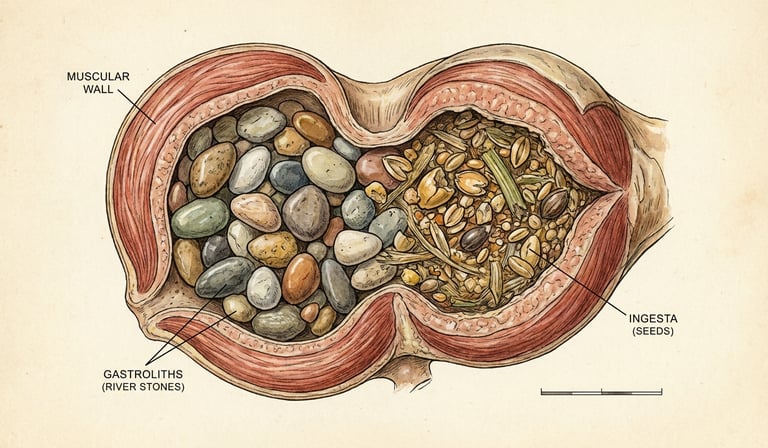
Birds do not chew with their mouths. They chew with a muscular organ called the gizzard, or ventriculus. According to Bairbre O'Malley in Clinical Anatomy and Physiology of Avian Species, avian skin and skeletal structures are evolved for extreme weight reduction. By moving the "teeth" from the head to the gizzard, the bird keeps its center of gravity stable, which is a requirement for controlled flight.
The gizzard is a powerful muscle lined with a tough, sandpaper-like material called the koilin layer. This lining protects the organ while it performs the heavy work of pulverization. Many species accelerate this process by swallowing "gastroliths," which are small stones, sand, or grit. These stones act as internal millstones. When the gizzard muscles contract, the grit grinds the food into a digestible paste.
Grit is found. Stones are swallowed. Digestion begins.
The gizzard moves the heavy mechanical work of chewing from the head to the bird's center of mass.
This system is so effective that some birds can process items that would choke a mammal of similar size. VIVO Pathophysiology researchers point out that the esophagus in many birds is surprisingly large in diameter, allowing them to swallow large meals whole before the gastric mill goes to work. Before the food even reaches the stomach, many birds use a "crop," which is an esophageal pouch that acts as a storage tank. This allows a bird to gorge quickly in a dangerous open area and then retreat to safety to process the meal slowly.
When the Gastric Mill Meets Modern Pollution
The "Weight-Shifting Principle" is a framework for understanding why birds are so sensitive to environmental changes. Because they rely on environmental grit for digestion, they are uniquely vulnerable to soil contamination. If a bird cannot find clean pebbles, it will swallow whatever small, hard objects are available.
Ecosystem consequences are immediate when the "grit" becomes toxic. In areas with high lead contamination or microplastic accumulation, birds mistake lead shot or plastic fragments for necessary digestive stones. Once these items enter the gizzard, the grinding action intended to break down seeds instead breaks down the toxins, releasing them directly into the bloodstream. This turns the bird's most efficient survival tool into a delivery system for poison.
Biodiversity loss in avian populations also has a literal cost for human food security. Many plants rely on the "scarification" provided by the gizzard. The grinding process thins the tough outer coating of seeds, which is often a biological requirement for germination. When birds disappear from an ecosystem, the plants they "chew" for also stop reproducing. The loss of these internal mills leads to a silent failure of forest regeneration that can cost billions in lost ecosystem services and carbon sequestration.
Next time you see a bird pecking at a gravel driveway, recognize it as a mechanic sourcing spare parts. They aren't just looking for food; they are looking for the tools to eat it. Challenge yourself to consider the "internal machinery" required for every creature you see in the wild, and ask what happens when the raw materials for that machinery are replaced by human waste.
This is exactly the kind of analysis we publish every week at The Science Impact. Subscribe free. Stay a step ahead.