
How Birds Breathe: The Two-Cycle Continuous Flow Guide
Discover the engineering behind avian respiration and why their lungs never need to expand.
Flight demands an energy budget that would bankrupt a mammal. To pay that debt, birds evolved a respiratory system that functions more like a jet turbine than a set of lungs. It is a loop that never closes. While you are stuck in a cycle of inhale-pause-exhale, a bird is enjoying a constant stream of fresh air, even while it is breathing out.
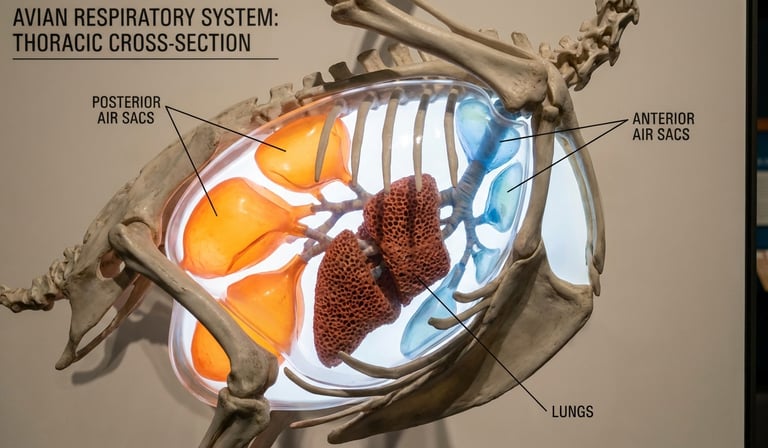
The secret is a series of air sacs that act as the system's bellows, leaving the lungs themselves small, rigid, and stationary. According to Jacquie Jacob of the University of Kentucky, most birds possess nine of these sacs. They do not exchange gases. They just move the air. This architecture allows the lungs to maintain a constant volume, which is why a peregrine falcon can dive at 320 kilometers per hour without its chest collapsing from the pressure.
The biggest cognitive trap in biology is the assumption that all lungs must expand to work. Mammalian lungs are tidal. Air goes in, stops, swaps oxygen for carbon dioxide, and goes out the same way it came. This is inherently inefficient because the "old" air mixes with the "new" air. You never actually empty your lungs.
Birds solved this by separating the pump from the filter. In the avian framework, the lungs are fixed. The air sacs do the pumping. It takes two full breaths for a single "packet" of air to move through the entire system. On the first inhalation, air goes to the rear sacs. On the first exhalation, it moves into the lungs. On the second inhalation, it moves to the front sacs. On the final exhalation, it finally leaves the body.
This two-cycle system ensures that the air in the lungs is always fresh. It is a continuous flow. This provides a massive advantage for endothermic animals that must maintain a high body temperature in freezing altitudes. If birds relied on tidal breathing, they would likely never have evolved the ability to sustain powered flight over long distances.
You can use this "flow-through" principle to understand efficiency in any system. When the intake and the exhaust use the same channel, you create a bottleneck. When you separate the two, you create a circuit. Birds are not just animals with feathers. They are biological solutions to the problem of gas-exchange bottlenecks.
Bird lungs utilize a crosscurrent blood flow mechanism that lets them grab oxygen even when its concentration is critically low.