
Three Rules of Genetic Adaptation Most People Never Learn
Most people think evolution is slow and vertical. Horizontal gene transfer breaks both assumptions. Here's what the science actually shows.
The Three Rules of Genetic Adaptation Most People Never Learn
In 1940, engineers at Bletchley Park didn't just crack the German Enigma codes. They disassembled the captured machines and absorbed the underlying logic of a system built by someone else entirely. The intellectual property moved sideways, not through inheritance. What mattered wasn't the lineage of the idea but the function it performed under pressure.
Certain fungi have been doing something structurally identical for millions of years. When fire-adapted species evolved the capacity to digest charcoal, some didn't generate that ability through the slow accumulation of mutations passed from parent to offspring. They acquired working genetic machinery directly from bacteria. Life borrowed the blueprint rather than designing it from scratch. That single fact should rewrite how most people think about where biological capabilities actually come from.
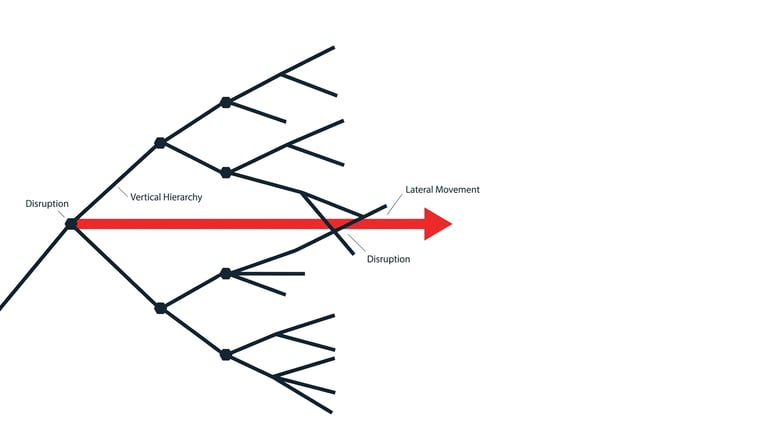
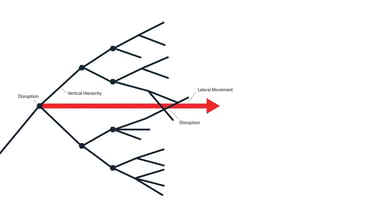
The Inheritance Illusion: Why the Standard Evolutionary Story Is Incomplete
Most people learned evolution as a vertical process. Parents pass genes to offspring. Mutations occur. Useful traits survive. Over millions of years, complex capabilities emerge. That framework isn't false, but it's missing a mechanism that operates on a completely different timescale.
Call the resulting misunderstanding the Inheritance Illusion: the assumption that genetic novelty can only travel downward through generations, never sideways between unrelated organisms. It's reinforced by every biology textbook that opens with Darwin and closes before the chapter on bacterial genetics. The result is a public mental model of evolution that's accurate for large organisms over long timescales but wrong for microbial life and increasingly wrong for the fungi we're only now beginning to sequence in detail.
The research basis for this correction is not new. Horizontal gene transfer was documented in bacteria as far back as 1928, when Frederick Griffith showed that bacteria could absorb genetic material from dead cells of a different strain and become permanently altered. The mechanism was confirmed molecularly by 1944. What's changed recently is the accumulation of genomic evidence showing how far beyond bacteria the phenomenon extends, and how consequential it is in ecological contexts we care about.
A January 2026 study in the Proceedings of the National Academy of Sciences, led by UC Riverside microbiologist Sydney Glassman, found that certain fire-adapted fungi carry charcoal-degrading genes acquired from bacteria through exactly this process. The finding puts cross-kingdom horizontal gene transfer in a new light: not a fringe bacterial behavior, but a real evolutionary pathway that shaped organisms living in some of the most ecologically important post-disturbance environments on Earth.
A Three-Step Framework for Reading Genetic Adaptation Without Getting Misled
This framework applies to any science story involving genetic capability: how an organism acquired it, how long it took, and whether the mechanism is relevant to human applications.
Step 1: Ask whether the capability was evolved or acquired. Most science coverage presents new genetic findings without specifying the mechanism of origin. "Fungi evolved to eat charcoal" and "fungi acquired bacterial genes that allow them to eat charcoal" are not equivalent statements. The second implies a mechanism that can potentially be reproduced, reverse-engineered, or monitored for spread. Before forming any opinion about a genetic discovery, identify which mechanism is actually being described.
Step 2: Map the mechanism to contexts you already care about. Horizontal gene transfer isn't abstract. It's the reason a patient in a hospital can contract a bacterial infection resistant to every available antibiotic within days of exposure. It's the reason synthetic biology researchers can insert genes from one organism into another to produce insulin, vaccines, and enzymes for industrial use. When genomic research identifies horizontal gene transfer in fire fungi, the practical relevance isn't the fungi themselves. It's the shared mechanism, newly documented in a stable, studyable system, that clarifies how far across biological kingdoms genetic information can travel and under what conditions.
Step 3: Update your understanding as sequencing costs fall. In 2001, sequencing a single human genome cost roughly $100 million. By 2023, it cost under $1,000. [VERIFY current figure for most recent sequencing cost] As genomic screening becomes routine across more species and ecosystems, the documented frequency of horizontal gene transfer events will almost certainly rise. Findings that seem exceptional today, like fire fungi carrying bacterial genes, will likely appear as representative examples of a broader pattern once the sequencing database is large enough. Calibrate your expectations accordingly: current findings are a floor, not a ceiling.
The Anchoring Effect and Why Old Biology Classes Still Govern Your Intuitions
Anchoring is the tendency to over-rely on the first piece of information encountered about a topic, even when better information arrives later. In economics, it shows up when an opening price shapes all subsequent negotiation, regardless of its accuracy. In science literacy, it shows up when a model learned at age 15 in a high school classroom shapes every subsequent encounter with a more complex version of the same topic.
For most adults, the anchor for evolution is a diagram showing a fish crawling onto land over millions of years. It's slow, it's vertical, it's linear. Horizontal gene transfer contradicts all three properties. It's rapid by evolutionary standards, it moves between unrelated lineages, and it doesn't follow a tree structure. It follows a network structure.
That's not a minor revision. It's a different geometry for understanding how life changes.
The anchoring effect is particularly stubborn here because the original model isn't wrong in its domain. Vertical inheritance really does drive evolution in animals over long timescales. The problem is that the anchor was never labeled with its scope. Nobody said "this model applies to large organisms over millions of years." It was presented as how evolution works, full stop.
You probably won't encounter a horizontal gene transfer story and think "wait, this contradicts what I learned." You'll just find it confusing, or treat it as an exotic exception, and move on. That's the anchoring effect doing its job. The correction isn't to replace the old model but to add a scope condition to it: vertical inheritance governs macroorganisms over geological time; horizontal transfer governs microorganisms and fungi over ecological time; and the boundary between those two regimes is blurrier than any textbook currently acknowledges.
Updating that single calibration point will change how clearly you read the next ten years of genomics coverage, because the findings are going to keep crossing that boundary in every direction.
Every week at The Science Impact, we publish exactly this kind of framework before it reaches mainstream news cycles. Subscribe free. Stay a step ahead.