
We're Searching for Life on the Wrong Planets | Opinion
The habitable zone framework ignores the violent collisions that make planets livable. The Gaia20ehk impact proves we need to fix that now.
We're Searching for Life on the Wrong Kind of Planet
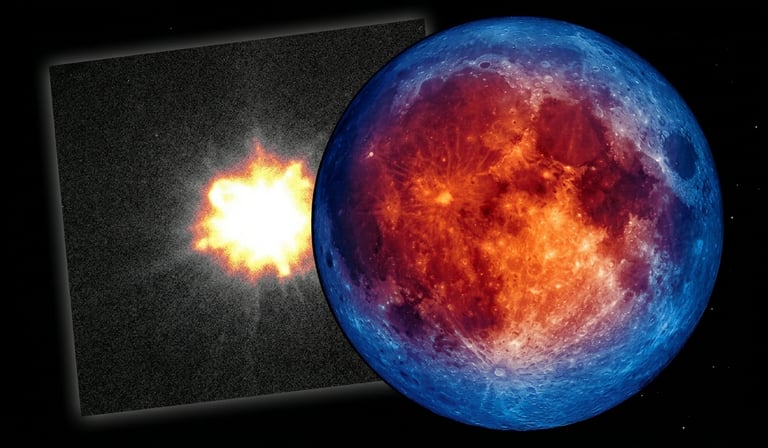
The discovery of a planetary collision around Gaia20ehk, published March 11, 2026 in The Astrophysical Journal Letters by researchers at the University of Washington, is being covered as a spectacle story. Two worlds destroyed each other 11,000 light-years away. Incredible. But the science community's actual response to this finding reveals a more uncomfortable argument: the framework we use to search for habitable worlds is built on the wrong premise, and this collision is evidence we should have acted on years ago.
Habitability Isn't About Stability. It's About Surviving the Right Violence.
The dominant framework for finding potentially life-bearing planets is the habitable zone: the orbital band around a star where liquid water could exist on a planet's surface. It's tidy, testable, and has driven billions of dollars of telescope time. It's also incomplete in a way that the Gaia20ehk event makes impossible to ignore.
Earth isn't habitable simply because of where it orbits. It's habitable partly because of what happened to it approximately 4.5 billion years ago, when a roughly Mars-sized body called Theia struck it in a catastrophic collision. That impact didn't just form the Moon. According to modeling published by researchers including Matija Cuk and Sarah Stewart in Science in 2012, it may have significantly altered Earth's rotation rate, contributed to the tidal mechanisms that drive ocean circulation, and produced a Moon large enough to stabilize Earth's axial tilt within a range that prevents extreme climate swings. Remove that impact, and the Earth you're standing on is likely a faster-spinning, less tidally stable, more climatically volatile world.
None of that appears in the habitable zone calculation.
James Davenport, an assistant research professor of astronomy at the University of Washington and senior author on the Gaia20ehk study, put the issue plainly: "How rare is the event that created the Earth and moon? That question is fundamental to astrobiology." His team estimates the Vera C. Rubin Observatory could find roughly 100 new planetary impacts over the next decade. That catalog doesn't exist yet. We're running one of the most expensive searches in science history, the search for extraterrestrial life, without knowing whether the violent event that made our planet habitable is common, rare, or somewhere in between.
The Best Defense of the Habitable Zone Framework Doesn't Survive Scrutiny
The strongest version of the counterargument runs like this: the habitable zone is a necessary first filter, not a complete one. Nobody credible argues it's the only condition that matters. Astrobiologists already discuss secondary factors including atmospheric composition, magnetic fields, plate tectonics, and tidal locking. Collision history is simply one more variable on a long list, and we can only measure what our instruments can detect.
That's fair as far as it goes.
It fails at a specific point. The habitable zone isn't just a first filter in practice. It's the dominant variable in how exoplanet discoveries get funded, prioritized, and communicated. When NASA's Kepler mission produced a list of potentially habitable planets, the criteria that determined which ones received follow-up attention were overwhelmingly based on orbital distance and estimated size. Collision history wasn't measurable, so it wasn't weighted. That's an understandable operational choice. What it isn't is a scientifically neutral one.
The collision that gave us a stabilizing Moon isn't listed as a coincidence in the astrobiology literature. It's listed as a potential prerequisite. Treating prerequisites as afterthoughts in the search design isn't intellectual humility. It's methodological drift, and it skews the population of planets we call "promising."
The Cost of Leaving Impact History Out of the Habitability Equation
The Gaia20ehk collision occurred at approximately one astronomical unit from its host star: the same orbital distance as Earth. That specific detail is why University of Washington researchers flagged it as the most structurally similar external analog to the Theia impact yet detected. The debris field, the thermal signature, the sequence of grazing encounters before the final catastrophic strike — all of it maps onto the leading model of how our Moon formed.
What the planetary science community needs now isn't more habitable zone candidates. It's a collision frequency dataset that tells us whether Earth-like impacts at Earth-like orbital distances happen often enough that the Moon is a typical outcome of rocky planet formation, or rarely enough that we are, in fact, an exception.
Until that dataset exists, our estimates of how many habitable worlds are out there rest on a calculation that omits one of the events most likely to determine whether a world becomes habitable at all. The Rubin Observatory can start building that dataset. The scientific community should treat doing so as a first-order priority in the next phase of astrobiology, not a secondary project to be slotted in around more traditional exoplanet characterization.
Hunting for life on stable, temperate worlds while ignoring the violent history that makes stability possible isn't thoroughness. It's searching in the light because the light is better there.
"This is the kind of take we publish every week at The Science Impact: positions backed by evidence, not by consensus. Subscribe free. Read science with a sharper eye."