
The Truth About Bird Evolution and Archaeopteryx
Learn why "true birds" are a moving target in science and how mosaic evolution explains the transition from dinosaurs.
In 1861, workers in the Solnhofen limestone beds of Germany pulled a slab of stone from the earth that upended the biological world. Three sentences later, the concept of a "missing link" was born. The fossil showed a creature with the delicate feathers of a robin and the terrifying claws of a raptor. We call it Archaeopteryx, and for over a century, it was the answer to the question of bird origins.
The cognitive trap most people fall into is the "Evolutionary Ladder." We want to see a straight line going from a heavy, ground-dwelling dinosaur to a light, soaring hawk. But evolution doesn't work in straight lines. It works in "mosaics." According to the CK-12 Foundation, there are roughly 10,000 species of birds today, and they are the result of millions of years of overlapping traits appearing at different times in different lineages.
The framework of Mosaic Evolution
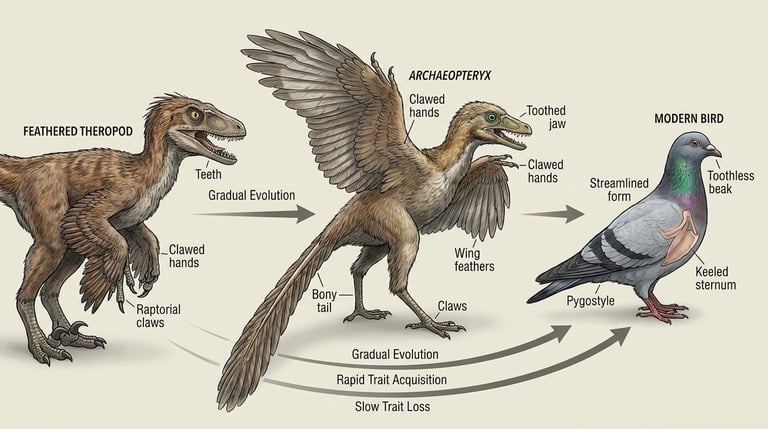
To understand why Archaeopteryx is often excluded from the "true bird" (Aves) category, you must use the framework of the "Avian Suite." This is the specific set of tools required to be a modern bird. These include a toothless beak, a fused wishbone (furcula), a keeled sternum for massive muscle attachment, and a unidirectional respiratory system.
Archaeopteryx only had some of these tools. It had a furcula and feathers, but it still had a heavy jaw filled with teeth and a long, bony tail that created significant drag. It was an "avialan," a member of the broader group that includes birds and their closest dinosaur relatives, but it wasn't a "true bird." Biology for Majors II from Clovis Community College notes that true birds (Neornithes) didn't emerge as a distinct, surviving group until much later, likely in the Late Cretaceous.
The "exact point" of transition is a moving target because different traits evolved at different speeds. This is mosaic evolution. Some dinosaurs had feathers for millions of years before they ever used them for flight. Some had hollow bones while they were still five ton predators on the ground. The transition to a "true bird" was less like a light switch and more like a long, slow sunrise.
Dismantling the Flight-First Trap
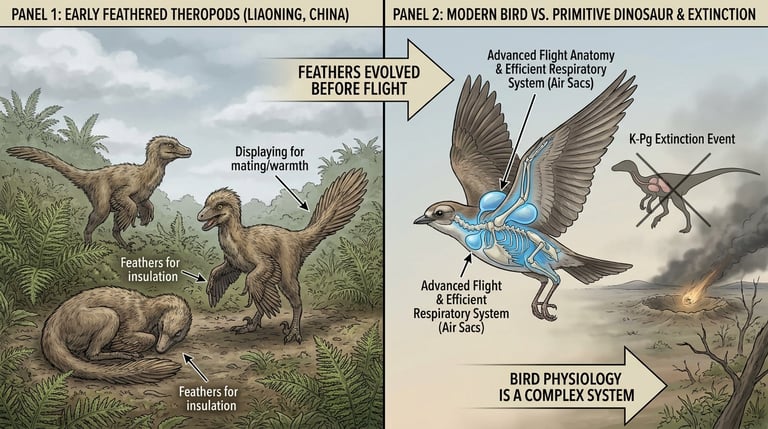
Another common trap is the assumption that feathers evolved for flight. This is likely false. According to fossil evidence from Liaoning Province in China, many small theropods were covered in downy feathers long before their limbs were capable of generating lift. Feathers likely first appeared for thermoregulation or mating displays.
When we exclude Archaeopteryx from the "true bird" category, we are acknowledging that "birdness" is a complex physiological architecture, not just the presence of wings. Modern birds are high-performance machines. Their respiratory system is 25 percent more efficient at extracting oxygen than the mammalian system, as noted by EBSCO Research Starters. This efficiency allowed them to survive the K-Pg extinction 66 million years ago while their "bird-like" dinosaur cousins, including those similar to Archaeopteryx, perished.
The cost of the final snap
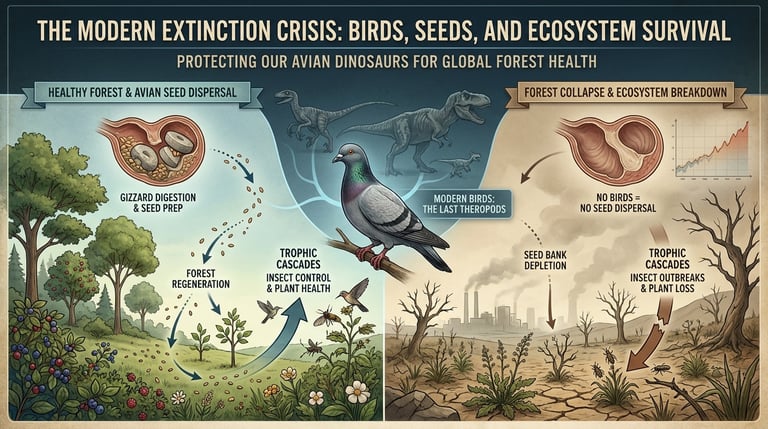
This evolutionary context reframes the current extinction crisis. We are not just losing animals: we are witnessing the potential end of the last surviving branch of the theropod dinosaurs. The 2026 Comprehensive Global Assessment warns that the loss of avian diversity triggers "trophic cascades." This is a fancy term for an ecosystem collapse.
Without birds to "chew" seeds in their gizzards and deposit them miles away, forests stop moving. When forests stop moving, they cannot adapt to shifting climates. The loss of these living dinosaurs isn't just a blow to our sense of wonder: it is a dismantling of the planetary life support system that has functioned since the end of the Mesozoic.
Next time you see a pigeon, don't see a pest. See a survivor of the greatest mass extinction in Earth's history. Ask yourself if we are willing to be the generation that finally kills off the dinosaurs for good.
This is exactly the kind of analysis we publish every week at The Science Impact. Subscribe free. Stay a step ahead.