
The Cosmic Origins of Biology: 3 Rules You Never Learned
We assume life requires a warm planet to form its basic ingredients. Discover why deep space ice is actually a far superior chemical laboratory.
How to Understand the Origins of Biology When Earth Centers the Narrative
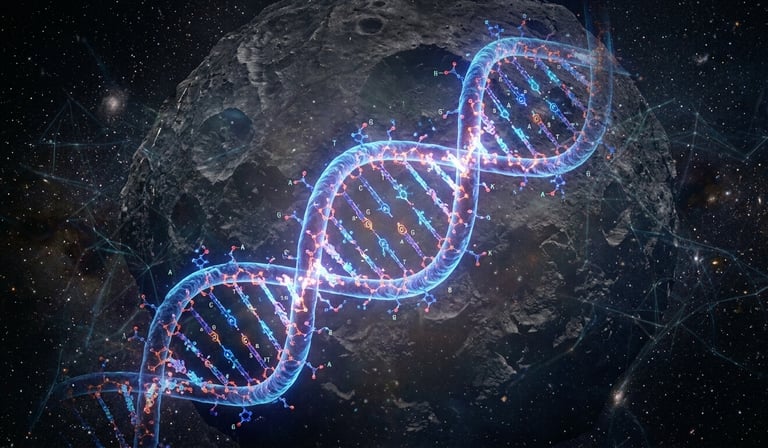
The Svalbard Global Seed Vault stores the potential for global agriculture inside a frozen Norwegian mountain. Asteroids perform the exact same function for our entire solar system. We spent centuries assuming biology required a warm planetary kitchen to cook up its basic ingredients. Deep space ice is actually a far superior chemical laboratory.
The Terracentric Incubation Trap
Our intuition fails us completely when we look at the night sky. Humans assume empty space is chemically sterile and incredibly hostile to complexity. This creates a severe cognitive blind spot I call the Terracentric Incubation Trap. People project their daily experience of life requiring liquid water onto the formation of the early universe.
Researchers assumed complex molecules like DNA components must originate in tidal pools or deep hydrothermal vents. That bias leads institutions to discount the freezing vacuum as a viable environment for organic synthesis. Yet ultraviolet radiation striking carbon-rich ice in deep space generates intense chemical complexity.
Early Earth was a chaotic and violent environment. Frequent impacts and global magma oceans created conditions that would incinerate delicate chemical bonds upon formation. Deep space offered a much safer environment for these molecules to assemble. The freezing vacuum acted as a massive stabilizing freezer for these fragile structures over millions of years.
A Three-Step Mental Model for Cosmic Chemistry
Flipping your perspective on planetary science requires a deliberate structural update. You need a reliable system to process news about organic compounds found off-world. Apply this framework to immediately separate signal from noise:
Step 1: The diagnostic shift. Stop viewing asteroids as chunks of dead masonry waiting to strike a planet. Treat them as perfectly preserved chemical archives. A carbonaceous chondrite asteroid is essentially a flash-frozen snapshot of the early solar nebula. It holds the raw code of the solar system before gravity compressed it into planets.
Step 2: The practical system. Evaluate new astrobiology discoveries strictly by their isolation protocols. The highest value data comes from sealed samples returned directly to facilities like the Johnson Space Center. Terrestrial meteorites sitting on Earth for 10,000 years are heavily contaminated by our own biosphere. Ground dirt renders those chemical readings ambiguous. Spacecraft retrieval eliminates that uncertainty entirely.
Step 3: How to keep updating this understanding. Expect the organic complexity found in space to increase predictably as our mass spectrometers improve. Scientists found single amino acids in the Murchison meteorite after it fell in 1969. We are mapping entire genetic alphabets today. Do not assume we have hit the ceiling of cosmic chemistry.
Surviving the Appeal to Nature
A specific cognitive hurdle makes this science incredibly hard to absorb. The Appeal to Nature fallacy tricks us into categorizing biological building blocks as inherently Earth-bound. We label rocks as inorganic objects and oceans as the exclusive cradle of life.
This artificial dividing line corrupts our scientific reasoning. We view the planet as a distinct entity from the solar system that formed it. The carbon atoms in your skin share a direct lineage with the organic dust drifting past Jupiter right now. When you stop segregating the universe into living planets and dead space, the mechanics of planetary formation make total sense. Asteroids are not separate from the biological process.
Earth simply provided a wet environment for pre-existing chemical codes to execute.
This is exactly the kind of analysis we publish every week for The Science Impact subscribers before it reaches mainstream news cycles. Subscribe free. Stay a step ahead.