
Coal Mine Batteries Are Real. The Hype Around Them Isn't
Oak Ridge's mine storage research is worth funding. The redemption narrative attached to it isn't. Here's what the evidence actually says.
Coal Mine Batteries Are a Real Idea. The Story Being Told About Them Is Not.
The research out of Oak Ridge National Laboratory on converting America's 500,000 abandoned coal mines into grid-scale energy storage deserves serious funding, rigorous engineering, and honest scrutiny from utility planners. What it doesn't deserve is the redemption arc being quietly assembled around it. That arc, the one where hollowed-out Appalachian towns get a second act and the energy transition gets a clean villain-to-hero story, is already doing what redemption arcs always do: softening the hard questions before anyone thinks to ask them.
The Physics Behind Mine-Based Storage Is Stronger Than Critics Acknowledge
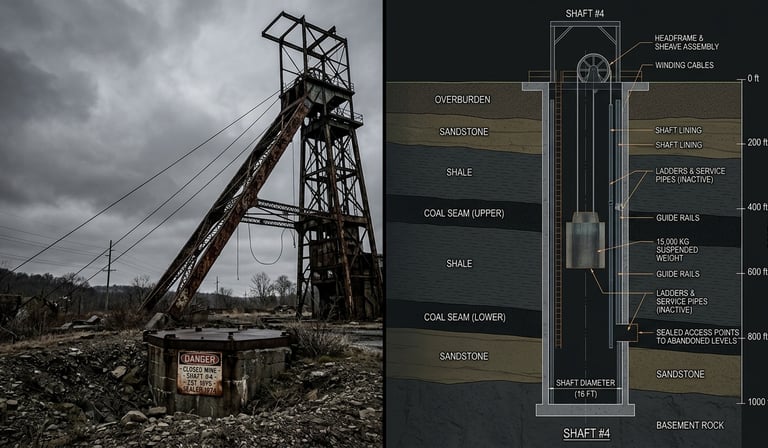
Start with what's actually true. Mine shafts that descend more than 1,000 feet create real gravitational potential. Excess electricity from the grid lifts a dense weight toward the top of that shaft. When grid demand rises, the weight descends and spins a generator. No chemical degradation. No lithium supply chain. No thermal runaway risk. That's not a metaphor. It's straightforward mechanical physics with a long industrial pedigree.
Pumped hydro inside closed-loop mine networks follows the same logic at a different scale. The deepest tunnels become the lower reservoir. Surface infrastructure becomes the upper one. No river gets dammed. No valley gets flooded.
Researchers at Oak Ridge, working with the U.S. Department of Energy, have spent years building a national mapping system to identify which of those 500,000 sites have the depth, geological stability, and proximity to existing transmission lines to make conversion viable. That's careful, specific work. The underlying physics isn't wishful thinking.
The problem is everything being built around the physics.
The "Second Chance" Framing Sets These Communities Up for a Second Collapse
Here is the counterargument worth taking seriously: the energy transition has delivered almost nothing to the coal communities it displaced. Wind and solar jobs haven't materialized in Appalachia at any scale that matches the closures they followed. Telling West Virginia and Pennsylvania towns that underground storage might bring technical work and infrastructure investment back isn't manipulation. It's a reasonable hope grounded in real geography. Many of these sites already sit near the heavy-duty power lines built during the mining era. The proximity argument is legitimate.
I take that position seriously. And then I look at the evidence.
Oak Ridge's database identifies candidates. No mine-based gravity storage facility operates at commercial scale anywhere in the United States. No publicly confirmed offtake agreements have been announced. Green Gravity, the Australian company developing gravity-weight storage in mine shafts, has run pilot projects but has not published peer-reviewed cost data from operating commercial-scale facilities [VERIFY]. The initiative, as of early 2026, is still in the mapping and feasibility phase.
When publications lead with "500,000 mines could become giant batteries," communities reading those headlines aren't processing a research update. They're processing a commitment. That gap is where the second disappointment gets built, and it gets built quietly, long before the press is paying attention again.
Honest Probability Is Not Pessimism. It's the Minimum Respect Owed.
The structural case for mine-based storage is real and urgent. The U.S. electrical grid needs long-duration storage: systems that hold energy for eight or more hours to smooth the variability of solar and wind. Lithium-ion batteries, which dominate current deployment, are cost-effective at roughly four hours of storage and become increasingly uneconomical beyond that. Mine-based gravity and pumped hydro systems could fill that gap if they can be deployed at competitive cost and adequate speed.
Both conditions are unproven at scale. Each site requires bespoke engineering because no two mine networks are structurally identical. That's expensive. It's also slow, at precisely the moment the grid needs solutions that are neither.
None of that makes the research wrong. It makes it research. The mistake isn't pursuing mine-based storage. The mistake is communicating it as something closer to a plan than it currently is, because the communities being asked to believe in it have already lived through the consequences of that particular category of mistake.
Wrapping a legitimate research program in a resurrection narrative doesn't accelerate the science. It creates political pressure to announce momentum before momentum exists, and it trains communities to wait for the next promising headline instead of demanding the structural investments, retraining programs, and direct economic support that don't require a breakthrough to deliver.
The coal mine storage idea deserves a serious future. The communities it's being sold to deserve a present tense.
"This is the kind of take we publish every week at The Science Impact: positions backed by evidence, not by consensus. Subscribe free. Read science with a sharper eye."