
What Cloning in Nature Actually Teaches Us About Survival
Asexual species should go extinct. The ones that don't reveal how evolution solves problems we didn't know existed. Here's the framework to understand why.
Cloning in Nature: What Evolution Actually Does With Genetic Dead Ends
In 1928, a Soviet agronomist named Nikolai Vavilov mapped the global centers of crop diversity and found something counterintuitive: the most genetically varied plant populations weren't the healthiest ones spreading fastest. The most resilient were the ones that had survived bottlenecks — populations pushed to the edge, forced to solve genetic problems that wider populations never had to face. Pressure, not abundance, built the tools that lasted.
The Amazon molly is 100,000 years of the same lesson.
The Extinction Myth That Textbooks Still Teach
Most people who've taken a biology class carry a version of this idea: sex exists because it prevents genetic decay. Without the constant reshuffling of chromosomes, mutations stack up unchecked. Asexual species are evolutionary dead ends, tolerated briefly by nature but ultimately doomed. This is sometimes called the Red Queen Hypothesis: you have to keep running, genetically speaking, just to stay in place.
The problem is that this model was built on theory and extrapolation, not comprehensive genomic evidence from long-lived asexual vertebrates. Researchers had studied short-lived microbes and plants, then applied the math upward. The Amazon molly, a vertebrate cloning species that has persisted for ten times longer than the models predicted it should, exposes a structural flaw in that reasoning.
Call this the Extinction Certainty Trap: the tendency to mistake a model's prediction for an observed outcome, then stop looking for the mechanism that contradicts it. It's a form of premature closure, documented in the psychology of scientific reasoning by researchers including Kevin Dunbar at Dartmouth, who studied how scientists handle anomalous data. The default is to dismiss the anomaly. The better move is to study it harder.
Amazon mollies were an anomaly for decades. The study published in Nature in March 2026 is what happens when someone finally studies them harder.

The Three-Step Framework for Reading Evolutionary Surprises
When a finding contradicts an established model, most readers have two options: accept the headline uncritically, or dismiss it as hype. Neither is useful. Here's a more reliable way to evaluate claims like the Amazon molly discovery.
Step 1: Identify what the model predicted and what the data actually shows. The prediction was extinction within 10,000 years due to mutational accumulation. The data shows a species 100,000 years old with a genome that is not collapsing. The gap between those two things is the story. Not the fish itself — the gap.
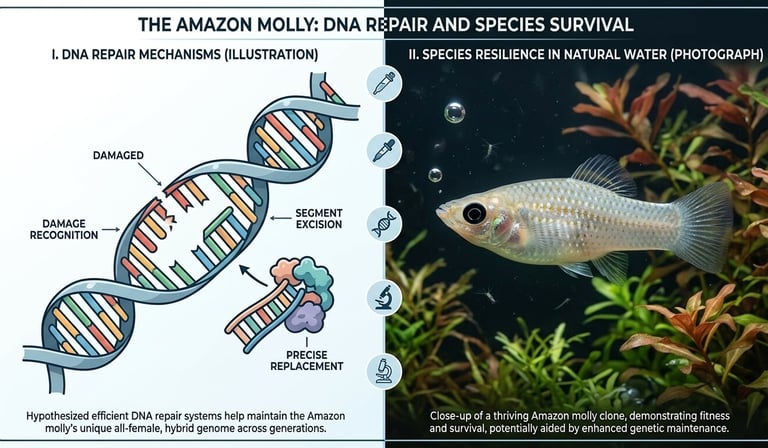
Step 2: Find the proposed mechanism and ask whether it's been measured or inferred. In this case, the mechanism is gene conversion: DNA repair using a paired chromosomal sequence as a template. The Ludwig Maximilian University of Munich team didn't infer this was happening. They sequenced genomes from multiple Amazon molly individuals and measured gene conversion rates directly, comparing them to sexually reproducing relatives. That distinction — measured versus inferred — is the single most important question you can ask about any biological claim.
Step 3: Track the distance between the finding and the application. Ricemeyer noted that understanding gene conversion in Amazon mollies could have applications in cancer treatment. That may be true. The distance between a fish genome study and a human clinical protocol is real and large. File the application under "worth watching," not "imminent." Return to it in three years and see what the follow-up literature says.
This framework applies to almost every biology story you'll encounter. The species changes. The mechanism changes. The structure of the question doesn't.
The Comfort of Finality
The psychological trap most active in how people consume evolutionary biology is what cognitive scientists call Closure Motivation: the deep discomfort with unanswered questions, and the corresponding pull toward explanations that feel complete. The Red Queen model felt complete. Sexual reproduction prevents genetic decay. Asexual species go extinct. Case closed.
Closure Motivation, first described formally by psychologist Arie Kruglanski at the University of Maryland, predicts that people under this drive will seize on the first satisfying explanation and resist revising it, even when contradictory evidence surfaces. In science journalism, this shows up as the tendency to cover findings that confirm existing narratives and ignore or underplay findings that complicate them. The Amazon molly story got modest coverage for years precisely because it was an inconvenient outlier.
The 2026 Nature paper changes that. It doesn't just say the fish survived. It shows the mechanism. And mechanisms, unlike anomalies, demand explanation.
The instinct to want biology to be settled is understandable. Living systems are staggeringly complex, and uncertainty is uncomfortable. But the history of medicine is built on the cases that didn't fit. Penicillin came from contamination. The link between H. pylori and ulcers was dismissed for a decade because it violated the consensus that stomach acid killed all bacteria. The Amazon molly's gene conversion machinery was sitting in plain sight for 100,000 years, waiting for someone to stop assuming it couldn't be there.
The next time a biology story contradicts what you learned in school, that's not a reason to be skeptical. It's a reason to read the methods section.
The Science Impact publishes this kind of analysis every week — before it reaches mainstream news cycles. Subscribe free. Stay a step ahead.