
CERN Found Particle 80: What the Upgrade Really Proved
LHCb confirmed a new baryon at 7 sigma. The real story: one year of upgraded data outpaced a decade of the original detector.
CERN Just Confirmed Particle Number 80. Here's What the Coverage Left Out.
On March 17, 2026, the LHCb collaboration at CERN confirmed the existence of the Ξcc⁺, or Xi-cc-plus, a baryon built from two charm quarks and one down quark that sits roughly four times heavier than a proton. The finding, announced at the Rencontres de Moriond Electroweak conference in Italy, cleared a statistical significance of seven sigma, well past the five-sigma threshold physicists require before claiming a discovery. It's the 80th hadron the Large Hadron Collider has found.
Nearly every piece of coverage explained the particle's quark composition. The more significant story is what the upgraded machine just proved it can do.
One Year of Data Did What a Decade Couldn't
More than 20 years ago, the SELEX experiment at Fermilab reported a signal suggesting the Ξcc⁺ existed — but at a mass significantly lighter than theory predicted. Follow-up searches by four separate experiments, FOCUS, BaBar, Belle, and earlier runs of LHCb itself, found nothing. The question sat open for two decades.
One year of data from the upgraded LHCb detector closed it at seven sigma.
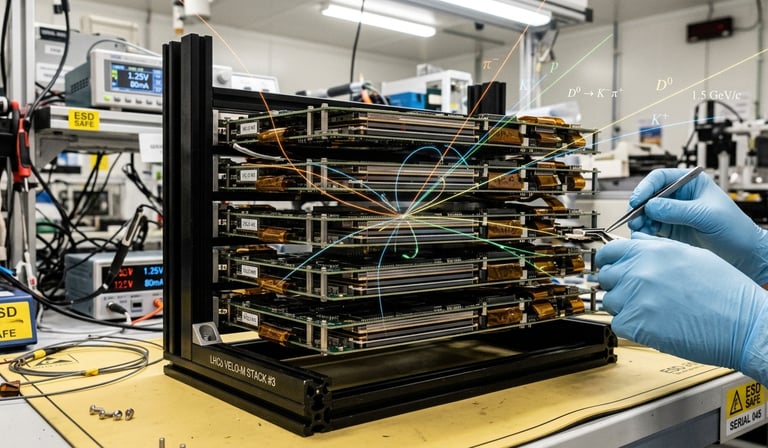
Tim Gershon of the University of Warwick, elected to lead the LHCb collaboration from July 2026, was precise about what that means: the discovery showed the team could now make measurements with just one year of data that were out of reach using a decade of data from the original detector. The upgraded detector, completed in 2023 after more than a decade of construction by over 1,000 scientists from 20 countries, takes 40 million images of particle collisions per second. Dr. Stefano De Capua of the University of Manchester, who led silicon detector module production, described it as a camera firing at that speed continuously, using a custom silicon chip that also has a variant in use for medical imaging. The UK, funded through the Science and Technology Facilities Council, made the largest national contribution to the upgrade.
CERN Director-General Mark Thomson called the result a demonstration of LHCb's unique capabilities within the broader LHC program. The sharper point is what those capabilities are now aimed at. The Ξcc⁺ confirms the Standard Model, physics' current theory of all known particles and forces. Finding a predicted particle isn't the same as finding new physics. LHCb's primary mission is to identify tiny deviations between observed particle decay rates and what the Standard Model predicts. Any confirmed deviation would be the first hard evidence of physics beyond the model.
The detector that just found particle number 80 is the same instrument hunting for those deviations.
What This Discovery Points Toward
The scientific paper confirming the Ξcc⁺ hadn't been published at time of writing, but the Moriond conference presentation is publicly available through the LHCb outreach page. That paper will contain the systematic uncertainties and effect sizes that determine how cleanly this measurement fits theory.
The results that will matter most from this upgraded detector won't be new baryons. They'll be precise measurements of rare decays in B mesons and D mesons, where the Standard Model makes extraordinarily tight numerical predictions. Any measurement that doesn't match is the finding physicists are actually waiting for. LHCb Upgrade 2, in planning now, will pair with the High-Luminosity LHC accelerator for even higher data volumes. The silicon chip Dr. De Capua's team built for the tracker is already adapted for medical imaging, a reminder that collider hardware rarely stays inside physics labs.
The LHCb collaboration's public results page publishes every new measurement as it's approved. The rare decay results are the ones worth watching.
Twenty-some years ago, a claimed sighting of this particle couldn't survive scrutiny from four independent experiments. The Ξcc⁺ confirmed in March 2026 sits at a measured mass of 3,619.97 MeV/c², consistent with theoretical predictions and incompatible with the earlier claim. That's the clearest evidence of what a generation of hardware investment actually looks like.
The Science Impact newsletter goes deeper than this, every week. Real analysis. Zero hype. Subscribe free and understand the discoveries before they become dinner-table debates.