
California Protects Mountain Lions and Manages Them Into Corners
California just listed coastal mountain lions as threatened. Then it sent police to respond to a Palo Alto sighting. The contradiction has a real ecological cost.
We Protect Mountain Lions on Paper and Manage Them Into Corners in Practice
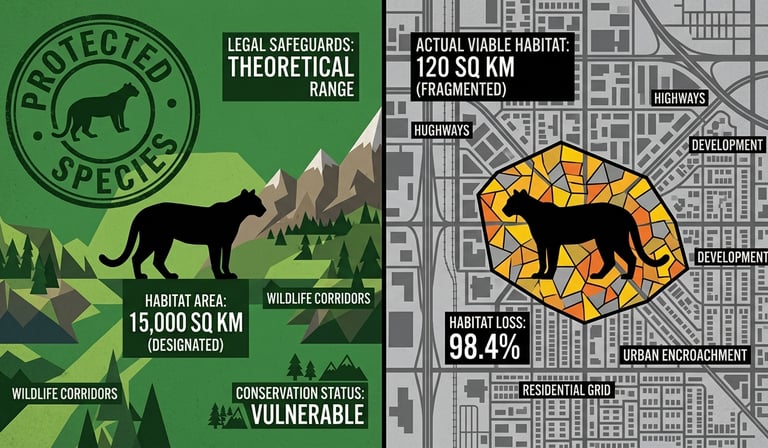
California voted in February 2026 to list coastal mountain lion populations as threatened under the California Endangered Species Act, a decision backed by documented evidence of genetic isolation, suppressed reproduction, and physical signs of inbreeding in multiple populations. The state is also funding wildlife crossings, habitat connectivity grants, and population monitoring at scale. By every institutional signal, California takes mountain lion conservation seriously.
Then a lion walks through a Palo Alto neighborhood, and the response is: police cruisers, Animal Control, CDFW officers, a community alert, and three hours of active search before the animal quietly disappears back into open space on its own. The messaging is calm and measured. The subtext is clear: this is a problem to be contained. That framing isn't just wrong ecologically. It's actively undercutting the conservation investments the state just made.
California's "Hazing" Policy Treats the Symptom While the Disease Gets Worse
The standard CDFW response to urban mountain lion encounters is what wildlife managers call hazing: using noise, lights, and human presence to drive animals away from residential areas and condition them to associate urban edges with negative stimuli. The protocol is designed to reduce human-wildlife conflict, and it succeeds on that narrow metric. Individual animals do move away from the hazing zone.
What it doesn't address is why the animal was there in the first place. Research by the Bay Area Puma Project, published in peer-reviewed reports tracking GPS-collared individuals on the San Francisco Peninsula, has consistently shown that the lions appearing at urban edges are overwhelmingly young males displaced from established territories by dominant adults. They're not learning to live near humans. They're attempting to cross a fragmented landscape in search of unoccupied territory and mates, and the urban edge is what they hit when the natural corridor runs out.
Hazing a young dispersing male away from a Palo Alto street pushes him back into a habitat patch that already has too many lions competing for too little territory. It doesn't reduce the pressure that drove him to the edge. CDFW's own February 2026 status review identified effective population size as a critical vulnerability across coastal and Southern California mountain lion populations, and noted that inbreeding indicators were already physically present in several groups. You cannot simultaneously acknowledge that these populations are genetically bottlenecked due to habitat fragmentation and respond to the symptoms of that fragmentation with protocols designed to keep the animals out of sight.
The Wildlife Crossing Argument Supports the Position, Not the Counter
The most serious objection to this critique is that California has actually been investing in the structural fix: wildlife crossings, habitat corridors, and the Wallis Annenberg Wildlife Crossing over US-101 in Los Angeles County, now under construction after securing over $87 million in public and private funding. If the crossings get built, the connectivity gets restored, and the urban edge encounters become less frequent over time. Give the infrastructure time to work before condemning the management approach.
This is a genuine and well-resourced effort. I'm not dismissing it.
The problem is that crossing infrastructure and hazing protocols are being run as parallel programs that don't talk to each other. Crossings are built by transportation and habitat agencies. Urban encounter responses are managed by wildlife officers on a call-by-call basis. There's no feedback loop connecting observed encounter patterns to crossing placement priorities or to the specific corridor gaps that produce the most displacement events. The Bay Area, which generated at least nine documented mountain lion sightings in July 2025 alone across San Francisco, Berkeley, Terra Linda, and the East Bay, has no equivalent to the Annenberg crossing either funded or in active planning as of this writing.
Crossings solve the problem only where they're built and only if the animals can find them. Urban encounter data is, in principle, the most direct available signal about where the gaps are. Using it as an input for infrastructure planning would sharpen decisions about where the next dollar should go. Instead, it's being used exclusively for incident response, then discarded.
The Accountability Gap: What Gets Measured Gets Managed, and the Wrong Things Are Being Measured
The metric California wildlife management tracks in urban encounters is human safety and conflict reduction. Both matter. Neither tells you whether the mountain lion population's ecological function is being preserved or eroded.
Quantifying the ecosystem services mountain lions actually provide in the urban-wildland fringe would change the conversation. Research by Mark Elbroch and colleagues at Panthera Foundation has documented that mountain lion predation in California reduces deer population pressure on riparian vegetation, which cascades into stream health, songbird populations, and soil stability in ways that generate real measurable value. The specific dollar figures attributed to trophic cascade benefits from apex predators vary by study and region, but the conservation biology literature consistently supports the direction: removing or behaviorally suppressing apex predators degrades the services they provide.
When California lists a species as threatened and simultaneously manages its behavioral patterns in ways that impede its ecological function, it's paying for two outcomes that partially cancel each other out. The listing is worth nothing if the management protocols keep the listed species cornered in shrinking habitat patches, conditioned to avoid the urban corridors it needs to cross.
The Palo Alto lion in March 2026 deserved something better than a police response and a community alert. It deserved to be GPS-tagged, tracked for two weeks, and turned into a data point about exactly which corridor gap produced that displacement event and where the next infrastructure investment should land.
That's the program California hasn't built yet, and the gap between the conservation we fund and the management we practice is where the species is actually losing ground.
This is the kind of take we publish every week at SevScience— positions backed by evidence, not by consensus. Subscribe free. Read science with a sharper eye.