
Artemis II Launch April 1: The Risk Number NASA Withheld
NASA cleared Artemis II for a Moon mission on April 1. But the risk figure they refused to publish tells its own story. Read it here.
NASA Cleared Artemis II for Launch. Here's the Risk Number They Wouldn't Give You.
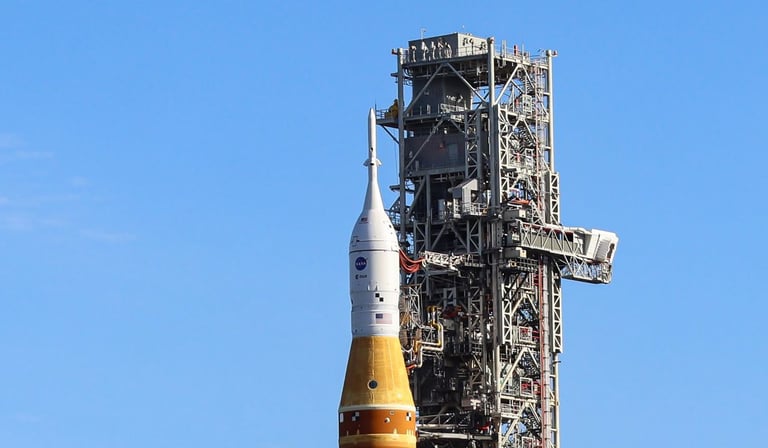
NASA completed its Artemis II Flight Readiness Review on March 12, 2026, and authorized a crewed mission to fly around the Moon for the first time in more than five decades. The target launch date is April 1, 2026, at 6:24 p.m. ET from Kennedy Space Center in Florida, with six backup windows on April 2, 3, 4, 5, 6, and 30. The Space Launch System rocket and Orion spacecraft are currently inside the Vehicle Assembly Building, roughly four miles from the launchpad, with a rollout planned for March 19.
The crew is four people: NASA astronauts Reid Wiseman, Victor Glover, and Christina Koch, plus Canadian Space Agency astronaut Jeremy Hansen. Their mission is a 10-day slingshot trajectory around the Moon, a test of the spacecraft and life-support systems in real deep-space conditions before a landing attempt on Artemis III. It's the second-ever flight of the SLS rocket, which had hydrogen leaks during a fueling test earlier this year and a helium flow problem caused by a blocked seal in a ground cable. Both issues were addressed. Whether the hydrogen situation resurfaces after the March 19 rollout is not yet confirmed.
The Number That Wasn't on the Podium
Every crewed NASA mission in recent memory has come with a published probability figure for spacecraft or crew loss. Before the 2022 Artemis I uncrewed test flight, the agency assessed a 1 in 125 chance of losing the Orion capsule. That figure anchored public understanding of the risk envelope.
Artemis II has no equivalent number. John Honeycutt, chair of the Artemis II Mission Management Team, declined to provide one at the March 12 briefing. His reasoning was candid: probabilistic figures for a rocket on only its second flight involve too much guesswork to be meaningful. His verbal range — "probably not 1 in 2, probably not 1 in 50" — is honest, but it's also a span wide enough to drive the SLS crawler through.
That absence matters for a specific reason. The Orion heat shield cracked and pitted during Artemis I reentry. NASA spent more than a year studying it and concluded the fix is to alter the capsule's return trajectory on Artemis II. Independent critics, as CNN reported in January 2026, have called that mitigation inadequate. Lori Glaze, NASA's acting associate administrator for Exploration Systems Development, said the agency has internal consensus that the heat shield is safe. The Flight Readiness Review ended with no dissenting concerns. What's missing from mainstream coverage is the distinction between institutional consensus and a documented, quantified safety margin.
None of this means the mission will fail. It means the public is being asked to assess a crewed deep-space flight with less technical transparency than previous missions provided.
Track the March 19 Rollout Before the Launch Headlines Hit
The clearest early signal for whether April 1 holds will come from the rollout itself, not from a press conference. NASA's Artemis mission blog at blogs.nasa.gov updates after each technical milestone and publishes specifics about hydrogen leak rates, propellant loading, and countdown anomalies. That's where the useful information appears first, well before it reaches any nightly news segment.
One piece of context the launch coverage will likely skip: Artemis II is a lunar flyby, not a lunar orbit mission. The crew won't brake into orbit or descend toward the surface. They'll execute a slingshot around the far side of the Moon and return. The significance of the mission is in what it tests — radiation exposure at lunar distance, Orion's life-support systems over ten days, and the heat shield under actual reentry conditions after deep-space transit. Those results will directly determine whether Artemis III, the planned landing mission, proceeds on schedule.
China's crewed lunar program, which aims for a Moon landing before 2030, puts a specific competitive edge on whether NASA's schedule holds. An April scrub that pushes into summer would affect that timeline in ways the agency won't say plainly but that congressional funding discussions certainly reflect.
Watch the rollout on March 19. That's the next real data point.
The Science Impact newsletter goes deeper than this, every week. Real analysis. Zero hype. Subscribe free and understand the discoveries before they become dinner-table debates.