
Why Apex Predators Keep Appearing Near Your Home
Mountain lion sightings near suburbs aren't random. Here's the ecological science behind urban predator encounters — and what they're actually telling you.
Why Apex Predators Keep Showing Up in Your Neighborhood: What the Science Actually Shows
In 1986, a pack of wolves crossed back into Yellowstone's Lamar Valley for the first time in 70 years. Nobody let them in. Prey populations had quietly been rebuilding the conditions that allowed predators to survive, and the animals followed the food. Within a decade, the reintroduction of wolves had restructured the river systems of Yellowstone through a chain of ecological effects that no one had predicted when the wolves were extirpated in the 1920s. Less elk grazing on riverbanks meant more trees, which stabilized soil, which altered the course of rivers.
Apex predators don't just occupy ecosystems. They run them. When they go missing, the system drifts. When they come back, even partially, the effects ripple in ways that are only legible if you understand what they were doing all along.
The Safety Illusion: Why Absence of Predators Doesn't Mean Safety From Them
There's a specific cognitive trap in how suburban and urban residents interpret wildlife encounters near residential areas. Call it the Baseline Blindness Trap: the assumption that the absence of visible predators means predators are absent. It combines a well-documented cognitive pattern called the Normalcy Bias with a much older evolutionary mistake, the one our ancestors made any time a landscape looked clear.
The behavioral science behind Normalcy Bias, documented across disaster psychology research including work by sociologist Lee Clarke at Rutgers University, describes the human tendency to interpret ambiguous signals as confirming that conditions are stable. We assume things will continue as they have been. A suburban neighborhood where mountain lions have never been reported becomes, in the resident's mental model, a place where mountain lions will never appear. That model collapses the moment one shows up on a Ring camera.
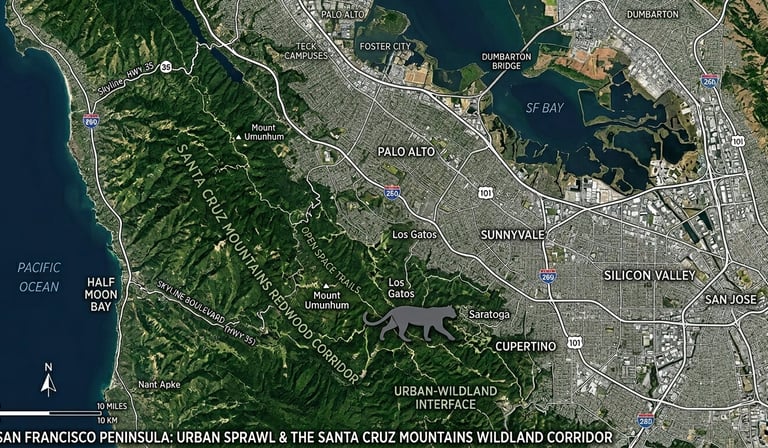
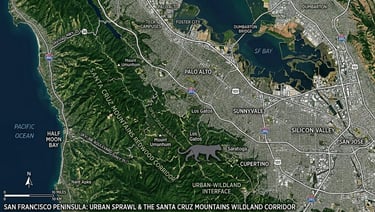
The truth about California's Bay Area is that mountain lions have lived in the Foothills and Santa Cruz Mountains throughout the period of human settlement. They didn't arrive recently. What changed is the urban edge, which expanded into the margins of their habitat and compressed the corridors they use to move between food sources and mates. Biologist Zara McDonald of the Bay Area Puma Project notes that urban edge encounters are increasing not because mountain lions are changing, but because development is pushing deeper into their habitat. They're navigating around us because they have to.
Three Steps to Understanding Urban Wildlife Encounters Accurately
Step 1: Stop treating sightings as isolated events and start reading them as corridor signals. A mountain lion sighting in a residential neighborhood is not evidence that the animal has chosen to live near humans. It's evidence that the corridor the animal was using to travel between habitat patches runs through or near that neighborhood. Male mountain lions can travel territories of up to roughly 200 square miles, following deer populations wherever they move. Palo Alto, Santa Cruz, Berkeley, and San Francisco are all urban interruptions in a landscape that predators evolved to cross. Each sighting is a data point about habitat connectivity, not about individual animal behavior gone wrong.
Step 2: Apply the trophic cascade lens before assuming danger. Trophic cascades are the chain effects of apex predator presence on every organism below them in the food web. Research published in the journal Biological Conservation by Mark Elbroch and colleagues at Panthera Foundation documented that mountain lions in California reduce deer population pressure on riparian vegetation, which in turn supports songbird populations, beaver activity, and stream health. A single mountain lion on a territory roughly the size of a mid-sized city produces measurable downstream ecological benefits for every organism in that system. The deer a mountain lion kills in the Santa Cruz Mountains is not disappearing from the ecosystem. Its nutrients redistribute into scavengers, soil, and water. Remove the lion and that regulation disappears.
Step 3: Watch the infrastructure decisions, not just the sightings. California has been investing millions of dollars in highway wildlife crossings to give mountain lions safe passage over or under roads that researchers report killed hundreds of mountain lions over a seven-year period. The Wallis Annenberg Wildlife Crossing over US-101 in Los Angeles County, now under construction, is the most publicized example. The Bay Area has smaller-scale corridor projects underway. These crossings aren't wildlife tourism amenities. They're the functional infrastructure that determines whether isolated mountain lion populations can exchange genetic material across fragmented habitat, or collapse inward. CDFW's status review already documented physical indicators of inbreeding in several populations, identifying effective population size as a critical vulnerability. Crossings are the intervention that changes that trajectory.
Availability Heuristic: Why One Sighting Distorts Your Risk Estimate
The Availability Heuristic is among the most reliably replicated findings in cognitive psychology. First described by Amos Tversky and Daniel Kahneman in their 1973 paper "Availability: A Heuristic for Judging Frequency and Probability," published in Cognitive Psychology, it describes the tendency to estimate how likely something is based on how easily an example comes to mind. Vivid, recent, emotionally charged examples inflate perceived probability regardless of actual frequency.
A mountain lion sighting in a Palo Alto neighborhood is vivid and easy to imagine once it's been reported. It will be the first thing you think of the next time you walk a trail at dusk in the Foothills. That's the heuristic doing its work. The actual statistical risk of a mountain lion attack on a human in California is extraordinarily low. The California Department of Fish and Wildlife records roughly 20 verified attacks on humans by mountain lions in the state since 1890, across a period during which tens of millions of people have hiked, camped, and lived adjacent to mountain lion habitat. Fatal attacks number fewer than ten in that entire span.
This doesn't mean encounters carry zero risk. It means your intuitive sense of that risk, sharpened by a vivid recent news story, will almost certainly overestimate the danger by orders of magnitude. The animals that show up in suburban corridors are nearly always young males displaced from territories by dominant adults. They're disoriented, not hunting. They want to find a route through the human landscape and disappear back into open space.
What actually increases risk is behavior, not proximity: approaching the animal, running from it, crouching, or bringing small children and unleashed dogs into dense vegetation near dawn and dusk. All of those are within your control. The lion's presence in your watershed is not, and managing it through infrastructure and habitat connectivity is a different problem with a different set of tools.
The next time a mountain lion shows up in a Bay Area neighborhood, you'll know what the sighting is actually telling you: that a predator essential to the health of the ecosystem you live beside is trying to survive inside a landscape that keeps shrinking around it. That's worth taking seriously, for the ecosystem's sake and for the animal's.
This is exactly the kind of analysis we publish every week for SevScience subscribers — before it reaches mainstream news cycles. Subscribe free. Stay a step ahead.