
Amazon Molly Cloning Mystery Solved: What the DNA Reveals
A fish that clones itself for 100,000 years shouldn't exist. Scientists found the genetic trick keeping it alive — and it links directly to cancer research.
The Fish That Clones Itself: What Science Just Found Inside Its DNA
A small freshwater fish with no males in its entire species has been making copies of itself for 100,000 years. That alone is strange enough. What researchers just published in the journal Nature on March 11, 2026 is stranger: scientists finally know how it survives doing so — and the answer has direct implications for cancer research.
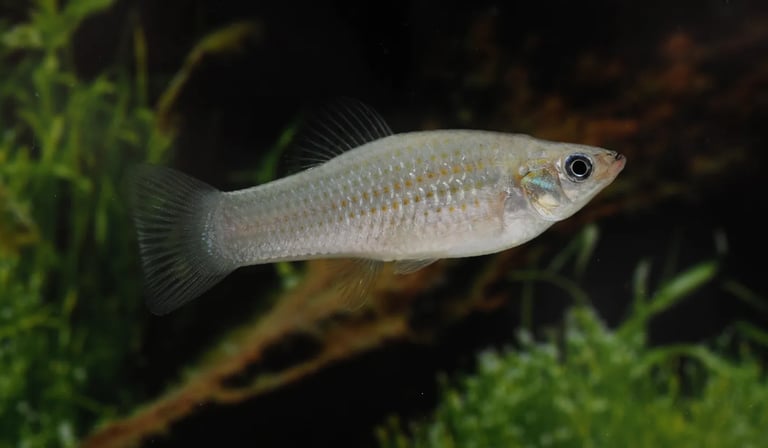
The species is Poecilia formosa, the Amazon molly, found in streams along the Texas-Mexico border. Every individual is female. Every offspring is a genetic clone of its mother. Edward Ricemeyer, computational biologist at Ludwig Maximilian University of Munich and co-author of the study, put the problem plainly: by every existing model of mutation accumulation in asexual species, Amazon mollies "should have gone extinct after 10,000 years or so."
They didn't. They're still here, 100,000 years later.
The Genetic Trick Nobody Was Looking For
Standard evolutionary theory holds that sexual reproduction exists, in large part, to shuffle the genetic deck. When two individuals combine DNA, harmful mutations get diluted, exposed to natural selection, and eventually weeded out. Without that shuffling, the theory predicts a slow accumulation of errors — a process called Muller's Ratchet — that should grind any clonal lineage toward extinction.
Amazon mollies appear to have found a workaround that no vertebrate was known to use at this scale. Ricemeyer's team discovered that the fish rely heavily on gene conversion: a process where a damaged segment of DNA gets overwritten using a matching sequence from a paired chromosome. Mammals, including humans, use gene conversion too, primarily as a repair mechanism after DNA breaks. In Amazon mollies, it appears to serve the same function as the genetic recombination that happens during sexual reproduction. It creates variation. It removes errors. It keeps the genome stable across generations.
"This is the first time it has actually been shown to be happening" in a vertebrate asexual species, Ricemeyer said. Scientists had theorized such a workaround might exist. Nobody had documented it at the genomic level until now.
Micah Dunthorn, microbiologist and professor at the University of Oslo, who was not involved in the study, noted the finding likely extends well beyond this one species. "It would be interesting to see how widespread this is within other animals, plants, and fungi," he said.
What a Cloning Fish Tells Us About Cancer
This is where the story stops being a wildlife curiosity and becomes something more urgent.
Cancer is, at its core, a clonal disease. A single mutated cell divides and divides, accumulating further errors, outcompeting healthy tissue, and eventually killing the organism that hosts it. The mechanism the Amazon molly uses to keep its clonal lineage genetically clean — gene conversion at scale — is precisely the kind of mechanism researchers want to understand better in the context of tumor biology.
Ricemeyer said as much directly: understanding these genetic forces "could have many applications," including treating cancer. A clonal lineage of cells that accumulates mutations and outgrows surrounding tissue is not an abstract description. It's a clinical definition of how most solid tumors behave.
The Amazon molly's genome may contain, in functional form, the blueprint for what human cells sometimes fail to do.
That's not a claim that a cure is imminent. The distance between a fish genome study and a human clinical application is measured in decades and billions of dollars. But the direction the research points is real, and worth tracking.
Follow the Research, Not the Press Release
The single most useful thing you can do this week is read the actual study, not the coverage of it. The paper was published in Nature, one of the two most rigorous peer-reviewed journals in science. The abstract is freely accessible at nature.com. Search "Amazon molly gene conversion 2026" and you'll find it within seconds.
Pay attention to the section on gene conversion rates. The data there is what separates this finding from speculative evolutionary biology. Ricemeyer's team didn't theorize that gene conversion was happening — they measured it in the genomes of multiple individuals and compared mutation rates against sexually reproducing relatives. That's the part most coverage glossed over.
If you follow cancer biology at all, the follow-up work to watch is whether any lab attempts to replicate the Amazon molly's gene conversion patterns in mammalian cell lines. That's the bridge between wildlife genetics and human medicine. It hasn't been built yet. But now there's a reason to build it.
The Amazon molly has been cloning itself since before our species painted caves. It turns out it was also quietly solving one of biology's harder problems the entire time.
The Science Impact newsletter goes deeper than this, every week. Real analysis. Zero hype. Subscribe free and understand the discoveries before they become dinner-table debates.